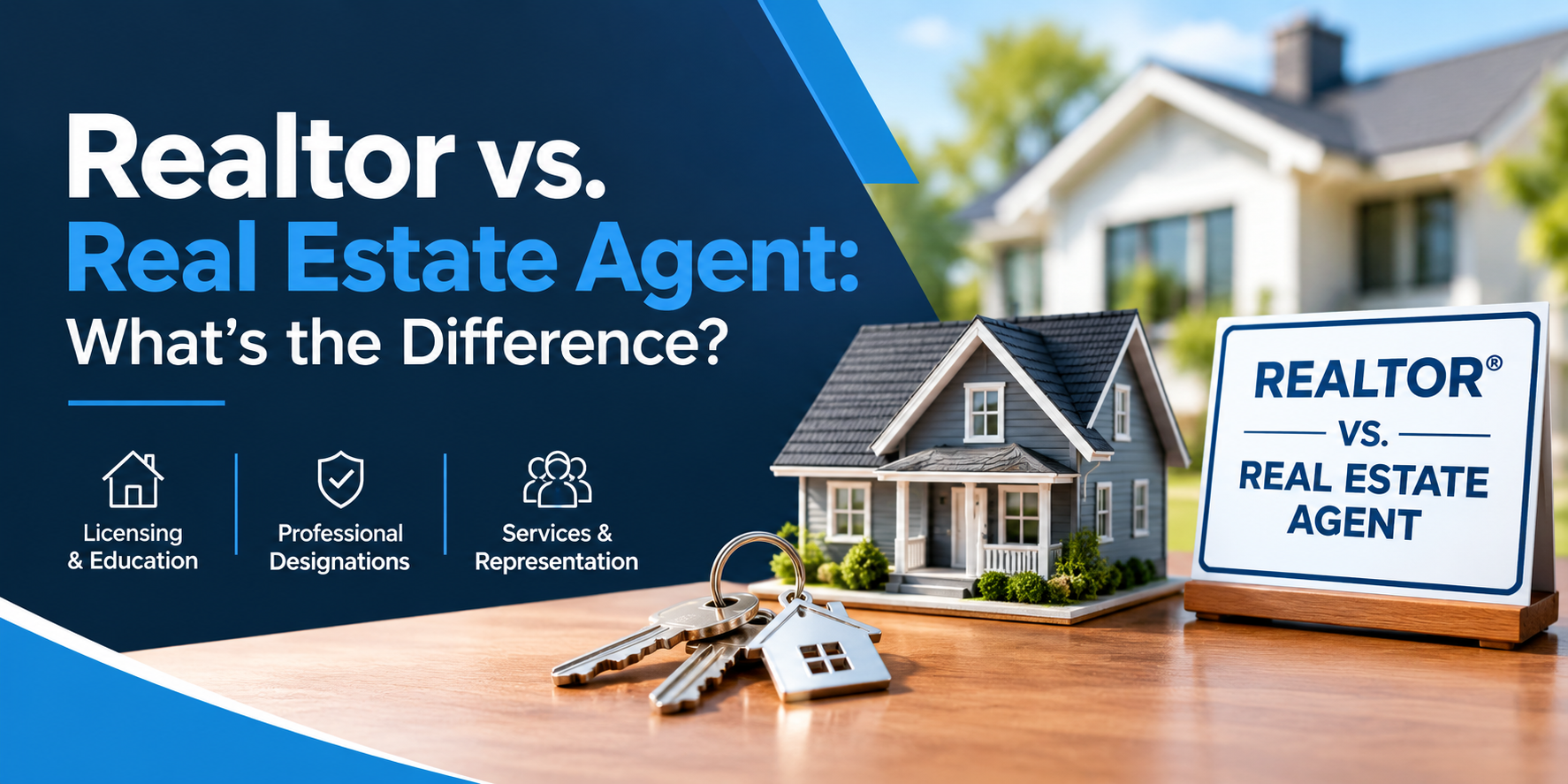
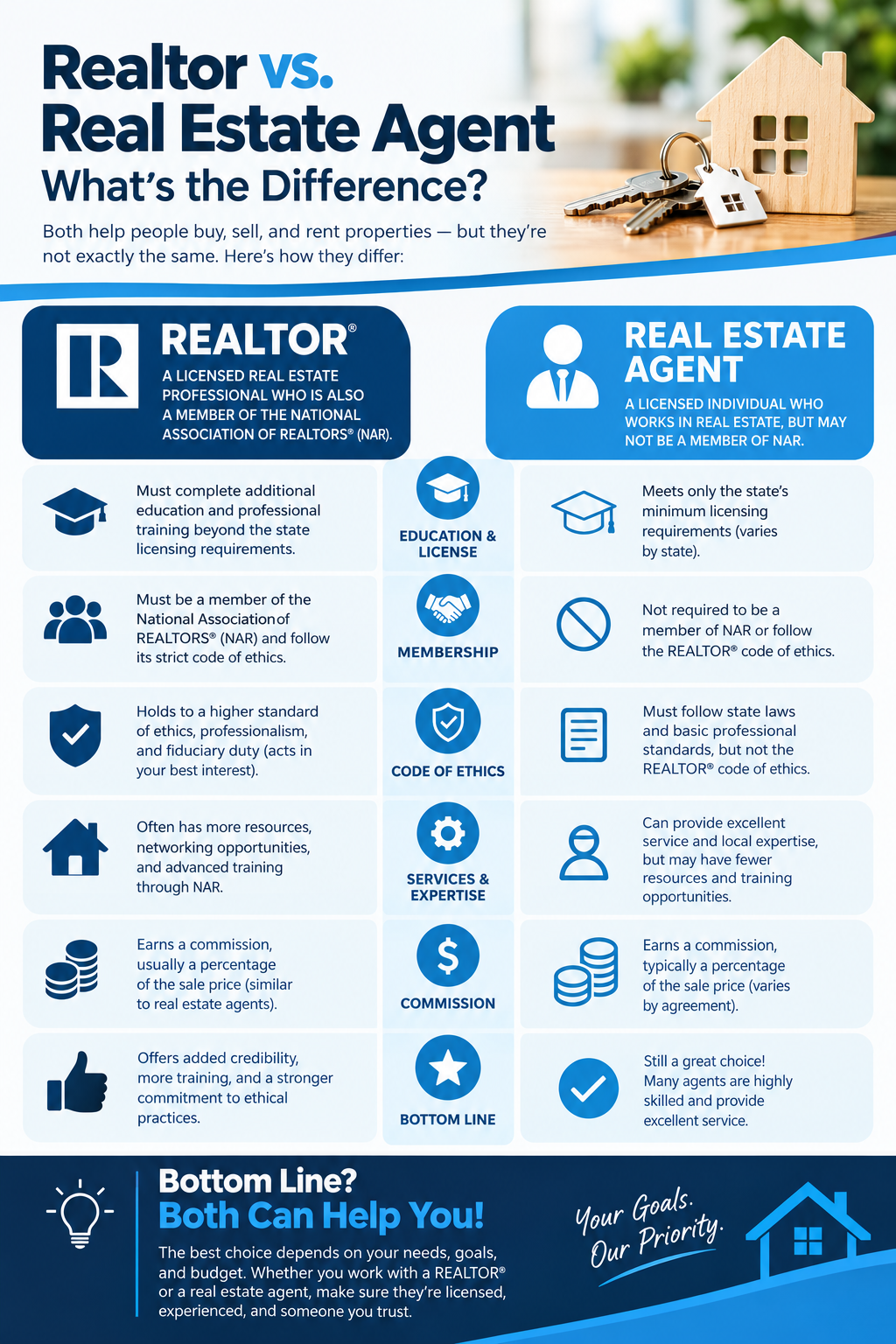
A Realtor is a real estate agent who is also a member of the National Association of Realtors (NAR) and has agreed to follow its 17-article Code of Ethics. A real estate agent is anyone holding a state real estate license. So every Realtor is a real estate agent, but not every real estate agent is a Realtor.
In California, both must be licensed by the Department of Real Estate (DRE) and work under a licensed broker. The difference is membership, ethics, and accountability, not who is legally allowed to help you buy or sell a home. If you are comparing professionals right now, our guide on
how to choose a realtor
walks through the full hiring process.
Realtor vs. Real Estate Agent at a Glance
Before going deeper, here is the side-by-side summary. Use it as a quick reference, then read the sections below for the context behind each row. If you are still early in your search, you may also want our
guide to choosing the right real estate agent for your needs.
| Category | Real Estate Agent | Realtor |
|---|---|---|
| Licensed by | State (DRE in California) | State (DRE in California), plus NAR membership |
| Membership | None required | NAR, state (C.A.R.), and local association |
| Code of Ethics | State laws and DRE regulations | State law plus the NAR Code of Ethics (17 Articles) |
| Dues | License and renewal fees only | License fees plus annual association dues |
| MLS access | Depends on local rules and brokerage | Usually included through the local association |
| Dispute process | State complaint process | State process plus association ethics and arbitration |
| Training | State pre-license and renewal education | State education plus mandatory Code of Ethics training |
What Is a Real Estate Agent?
A real estate agent, formally called a real estate salesperson in California, is a person who has met the state’s requirements to represent buyers, sellers, landlords, or tenants in a property transaction for compensation. To earn the license, a candidate must be at least 18, complete 135 hours of approved college-level coursework (Real Estate Principles, Real Estate Practice, and an elective), pass the state exam, submit fingerprints for a background check, and be sponsored by a licensed broker.
Our guide on
how to choose a realtor in San Diego
explains what to expect from a competent professional once they are licensed.
Agents do not work independently under their own authority. They hang their license with a broker, who is legally responsible for supervising their transactions and compliance. A new agent is licensed and legal on day one, but has no track record. A twenty-year agent is held to the same license rules, but brings thousands of hours of negotiation, inspection, and escrow experience.
KEY TAKEAWAY
The license alone tells you very little about quality. It is the entry ticket, not a performance rating.
It is worth reading the
pros and cons of purchasing a property
so you know which questions to ask whoever you hire.
Every licensed agent is bound by California law, including the duty to disclose material facts, the requirement to give the agency disclosure form, and the rules on advertising, trust funds, and record keeping. Violations can lead to discipline from the DRE, from fines to license suspension or revocation.
So an agent who is not a Realtor is not unregulated. The state is the main referee, and you can look up any license holder, including their status and any public disciplinary action, on the DRE’s public license search at
dre.ca.gov.
What Is a Realtor?
Realtor is a registered collective membership mark owned by the National Association of Realtors, which represents roughly 1.5 million members nationwide. Only active NAR members may use the title, and it is always written with a capital R.
The term is not a synonym for “agent” and it should not be used that way, which is a common mistake even in the news. NAR itself explains
when a real estate agent is a Realtor,
and the short version is that the agent has to opt in, pay dues, and accept the association’s standards.
Membership works on three levels. A California Realtor belongs to a local association (in San Diego that would be the San Diego Association of Realtors), the California Association of Realtors (C.A.R.), and NAR.
Each level charges dues, and each provides services such as legal hotlines, standardized contract forms, market data, advocacy on housing policy, and continuing education.
Those forms matter to consumers more than most people realize, because standardized contracts reduce the chance of confusing or one-sided terms. If you are selling,
choosing a listing agent to sell your house
is a good moment to ask which tools and contracts your agent uses.
Becoming a Realtor does not replace the state license. It sits on top of it. An agent who loses their license automatically cannot remain a Realtor, and a Realtor who violates the Code of Ethics can face association discipline in addition to state action.
That layered accountability is the main consumer argument for hiring a Realtor, and it is the reason many brokerages require or strongly encourage membership across their teams. To see how it plays out locally, our guide to the
top real estate agents in San Diego
shows how different professionals present their credentials.
The Key Differences Between a Realtor and a Real Estate Agent
The differences fall into five practical areas: membership and dues, the Code of Ethics, MLS access, education, and dispute resolution. Each one affects you differently depending on whether you are buying, selling, or renting.
Membership and Dues
A real estate agent pays the state for exams, licensing, and renewal. A Realtor pays all of that plus annual dues to the local association, the state association, and NAR.
In practice that is a meaningful yearly cost, which is why some experienced agents choose not to join, particularly those who do very little transaction volume or who work in niche areas such as commercial leasing.
Dues are an investment that a serious full-time agent in a competitive market usually views as worthwhile. When you
compare agents using our hiring checklist,
membership status is one quick data point alongside experience and reviews.
The Code of Ethics
The strongest difference is the NAR Code of Ethics. Adopted in 1913 and updated regularly since, it contains 17 Articles organized into three groups: duties to clients and customers, duties to the public, and duties to other Realtors.
Examples include the obligation to be honest about material facts, to avoid exaggeration or misrepresentation in advertising, to protect client funds, to cooperate with other agents, and to treat all parties fairly.
Realtors must also complete Code of Ethics training on a recurring cycle, currently every three years, to keep their membership active.
For a practical look at the questions this should prompt you to ask, see our
home viewing checklist,
which helps you stay objective while an agent is guiding you through properties.
Multiple Listing Service (MLS) Access
The MLS is the shared database of active listings that agents use to market homes and find properties for buyers. In many markets, access to the local MLS is tied to association membership, which is why Realtors typically have it automatically.
An agent who is not a Realtor may still reach the MLS through another route, such as a brokerage that holds a participant subscription, but the rules vary by region and by MLS.
“Do you have full MLS access, and will my home or search be handled through it?”
Full access is non-negotiable if you are selling, because the MLS is the engine that feeds Zillow, Redfin, Realtor.com, and most other consumer sites.
Our guide to
hiring an agent to sell your home
covers how listings reach buyers.
Education and Resources
Both groups complete state-mandated continuing education to renew a California license every four years. Realtors gain additional training through their associations, including classes on negotiation, new laws, fair housing, and technology, along with designations such as ABR (buyer representation), SRES (seniors), or CRS (residential specialist).
These designations are optional and separate from the basic Realtor title, so it is worth confirming what a given credential actually requires.
An agent who invests in training tends to understand topics like appraisals, appraisal gaps, and contingencies more deeply, so our explainer on
what an appraiser does in real estate
is a useful primer before you start negotiating.
Dispute Resolution and Accountability
If an agent who is not a Realtor causes you harm, your options are the DRE complaint process, small claims or civil court, and arbitration if your contract requires it.
If your agent is a Realtor, you have those same options plus the local association’s ethics complaint procedure and, in many cases, mediation or arbitration for disputes with other members.
An ethics hearing is not a legal judgment and cannot award damages in the way a court can, but it can result in fines, mandatory training, or suspension or expulsion from the association.
For buyers and sellers, that extra layer is a meaningful backstop. Reviewing the
essential real estate documents you need after closing
also helps you keep the records any dispute would depend on.
What About Brokers? Agent vs. Broker vs. Realtor
People often mix up three separate things: license level, job title, and association membership. In California there are two license levels. A salesperson (agent) must work under a broker. A broker has passed a higher-level exam and can operate independently or run a brokerage.
To qualify, a broker candidate typically needs at least two years of full-time experience as a salesperson within the last five years (with some exceptions for a four-year degree with a real estate major) plus additional college-level coursework.
A broker can also hire agents, and an agent who has earned a broker license may still choose to work under another broker, which is often called an associate broker.
REMEMBER THE DISTINCTION
Agent = license level |
Broker = higher license level |
Realtor = association membership
Realtor status is independent from both. A salesperson can be a Realtor, a broker can be a Realtor, and either can decline to join.
That is why you may see a business card that says “Broker, Realtor” and another that says “Real Estate Agent” with no mention of NAR at all.
When you interview candidates, ask for the license number and look it up, then ask separately about association membership. If you are comparing several local professionals, our post on the
top 10 real estate agents in San Diego
shows how experience and credentials are presented in practice.
Does It Matter If Your Agent Is a Realtor?
It matters somewhat, but it should not be the deciding factor. The title tells you that the agent has chosen to adopt a published ethics standard, is subject to peer review, and almost certainly has strong MLS access and professional resources.
What it cannot tell you is whether the agent knows your neighborhood, negotiates well, communicates promptly, or has handled situations like yours.
WHAT MATTERS MOST
There are excellent non-member agents and there are poor Realtors. Reputation, recent sales, client reviews, and the quality of the agent’s answers to your questions should carry more weight than a logo on a card.
Our full guide to
choosing a realtor in 2026
gives a step-by-step scorecard.
How Real Estate Agents Get Paid Today
Compensation is a topic where clarity matters more than the label. Since the NAR settlement took effect in August 2024, buyers working with an agent are generally expected to sign a written buyer representation agreement before touring homes, and offers of buyer-agent compensation can no longer appear on the MLS.
Commission is negotiable between you and your agent, and it is no longer assumed that the seller will automatically cover the buyer’s agent.
These changes apply to all agents who participate in the affected MLSs, not only Realtors, so you should read any agreement carefully and ask what services are included, how long it lasts, and how you can end it.
For a seller-side view of costs, see our article on
selecting a listing agent in San Diego.
How to Verify an Agent’s License and Realtor Status
Verification takes about five minutes and is the single best protection you have. Start with the DRE’s public license lookup: search by name or license number and confirm that the license is current, check which broker the agent works under, and review any disciplinary actions.
Then ask the agent whether they are a Realtor and with which local association. NAR and local associations offer membership verification tools, and the agent should be comfortable pointing you to them.
If you are early in your search and want to see what a thorough vetting process looks like, our
realtor selection guide
includes interview questions and red flags.
Verification is not only for buyers and sellers. Renters and tenants dealing with someone who claims to be a property manager or agent should also check the license, since fake listings and impersonation are a recurring problem in rental markets.
If the person representing a property cannot provide a verifiable license number, treat that as a warning. We cover related scams and screening steps in our guide to
how to find private landlords,
and in our overview of
rent-to-own homes in San Diego.
Questions to Ask Before You Hire Any Agent
Once you have confirmed credentials, use your interview to judge fit. a) Ask how many transactions the agent has closed in the past twelve months and in which neighborhoods.
b) Ask how they communicate, how quickly they respond, and whether you will work with them directly or with an assistant or a team. c) Ask for two or three recent client references and for a sample of how they price and market a listing or structure an offer.
The answers should be specific. Vague, rehearsed responses suggest the agent has little to show. Our
home viewing checklist
is also useful here, because a good agent will help you use it rather than rush you through showings.
Local expertise deserves special attention in a market as varied as San Diego County. An agent who knows Carlsbad Village may not know Escondido’s new developments or Oceanside’s coastal pockets.
If you are deciding where to live, compare our
Carlsbad vs. Oceanside vs. Escondido guide
and our
relocation guide for moving to Escondido.
The right agent should add information you could not find on your own.
Realtor vs. Real Estate Agent for Buyers and Sellers
If you are a buyer, your priorities are negotiation skill, access to listings, and honest advice on price and condition. A Realtor who knows the local MLS and has experience with appraisals and inspections gives you an advantage in competitive situations.
Whether the agent is a Realtor matters less than whether they have represented buyers in your price range and understand financing, which is also why a good agent can explain how a
buy vs. rent decision
changes with your budget and timeline.
If you are a seller, the stakes around marketing and MLS exposure are higher. Your listing agent controls photography, pricing strategy, showing logistics, and negotiations with buyers, so confirm that the agent will use full MLS syndication and ask for a written marketing plan.
A Realtor is not required for this, but you want proof that the agent can do it. Our article on
how to choose a listing agent to sell your house
lists the exact deliverables to request before signing a listing agreement.
Related Reading: Your Real Estate Hiring and Buying Cluster
This article is part of a larger set of guides built to help you hire the right professional and avoid costly mistakes.
If you want a complete walkthrough of the hiring process, begin with
how to choose a realtor.
If you need a broader comparison framework, read
how to choose the right real estate agent for your needs.
Sellers should continue with
choosing a listing agent to sell your house,
and anyone narrowing down professionals can compare names in our
top 10 San Diego real estate agents
post.
Frequently Asked Questions
Is a Realtor better than a real estate agent?
Not automatically. A Realtor has agreed to a published Code of Ethics and is subject to association oversight, which adds accountability. But skill, local knowledge, and communication matter just as much. Compare candidates on experience and results, and treat Realtor status as a plus. Our
realtor hiring guide
shows how to score each candidate.
Can a real estate agent call themselves a Realtor?
No. Only active members of the National Association of Realtors may use the Realtor title. An agent who is not a member who uses it risks association action and possible legal claims over the trademark. You can ask any agent to confirm membership and the local association they belong to before you sign an agreement.
Do you need a Realtor to buy or sell a house in California?
You do not need a Realtor, and you do not legally need an agent at all, but most buyers and sellers use a licensed professional because of contract complexity, disclosure rules, and negotiation. If you hire someone, they must hold a valid California license. See our
guide to selling with a listing agent
for what to expect.
What is the difference between a Realtor and a broker?
A broker is a license level, while Realtor is a membership. A broker has more education and experience than a salesperson and may run a brokerage. A Realtor is any licensed agent or broker who belongs to NAR. One person can be both a broker and a Realtor. Our
article on choosing the right real estate agent
explains how to compare them.
How do I check if someone is a licensed real estate agent in California?
Use the California Department of Real Estate’s public license search at
dre.ca.gov.
Enter the person’s name or license number to confirm the license is active, see their sponsoring broker, and review any disciplinary history. To confirm Realtor membership, ask the agent for their association or use the verification tools offered by NAR and local associations.
Do Realtors get paid more than other agents?
No. Compensation depends on the agreement you sign, not on membership. Commissions are negotiable, and since 2024 buyers typically sign a written agreement before touring homes. Review the terms carefully and see our
guide to choosing a listing agent
for questions to ask about fees.
Does the Realtor Code of Ethics protect consumers?
It adds a layer of protection by setting standards for honesty, disclosure, and fair treatment, and by giving consumers a way to file an ethics complaint with the local association. It does not replace state law or the courts. If you have a problem, you can use both the DRE and the association process. Our
post-closing documents guide
explains which records to keep.
The Bottom Line: Choose a Professional, Not Just a Title
The simplest way to remember the difference is this: every Realtor is a licensed real estate agent who has also joined a national association and committed to a higher ethical standard, while a real estate agent is anyone who holds a state license.
The title is a helpful signal, but it is only one signal. Verify the license, ask about membership, review recent results, and make sure the person understands your neighborhood and your goals. Those steps will protect you far better than any logo or acronym.
Ready to Talk With a Local Real Estate Professional?
If you are ready to talk with a local professional, Adam Kelley and the team at
Adam Kelley Real Estate
help buyers, sellers, and renters across San Diego, Carlsbad, Oceanside, Escondido, and surrounding North County communities.
Visit
our website
to start a conversation, ask any question from this guide, and get a clear, no-pressure plan for your next move.