San Diego County’s housing market spans from the rolling hills of Fallbrook to the bustling streets of Carlsbad, offering homebuyers a choice between rural serenity and urban energy. In 2024, San Diego recorded over 30,000 home sales, with rural and urban areas catering to distinct lifestyles. Whether you’re a first-time buyer, a family seeking space, or an investor eyeing growth, understanding these differences helps you find a home that fits your needs. This guide examines the pros and cons of rural vs. urban home buying in California, focusing on San Diego’s neighborhoods to inform your decision.
Understanding Rural and Urban Home Buying in San Diego
Rural and urban home buying in San Diego reflects California’s diverse real estate landscape. Rural areas like Fallbrook and Bonsall feature expansive lots, agricultural roots, and quiet communities. Properties often include vineyards, orchards, or fields, appealing to those seeking space. Urban areas, such as Carlsbad and San Marcos, are defined by dense populations, modern amenities, and business hubs. Condos, townhomes, and single-family homes dominate these cityscapes.
In 2024, rural Fallbrook homes listed at a median of $820,000, offering larger parcels than urban Carlsbad’s $1.25 million median. Urban properties appreciate faster, while rural homes provide affordability. San Diego’s market shows rural buyers prioritize land size, while urban buyers value convenience. This comparison explores key factors like cost of living comparison rural urban California, lifestyle, and infrastructure, with a focus on San Diego’s neighborhoods.
Cost of Living and Housing Affordability
Housing affordability shapes San Diego buyers’ decisions. Urban Carlsbad’s median home price reached $1.25 million in 2024, driven by coastal demand and amenities. These homes gain 5-7% annually, attracting investors. Rural Fallbrook, with a median of $820,000, offers larger properties, often 2-5 acres, ideal for families seeking space.
Property taxes average 1.2% in urban areas and 1% in rural ones. Urban buyers may face homeowners association fees of $200-$600 monthly, covering amenities like pools. Rural properties, free of such fees, might require $1,000-$3,000 annually for septic or well maintenance. For those interested in buying a home, explore our Buying a Property Service for guidance on the best deals in San Diego.Utility costs differ: urban homes use municipal water and electricity, averaging $200/month, while rural homes pay $250-$300 due to private systems.
Insurance varies, with rural areas facing higher premiums, around $2,000/year, due to wildfire risks, compared to urban $1,500. Closing costs, 2-5% of purchase price, and maintenance, scaling with rural property size, add to budgets. San Diego’s cost of living comparison rural urban California, 40% above national averages, makes these factors critical. Rural buyers save upfront, but urban buyers may see stronger returns.
Lifestyle and Community Differences
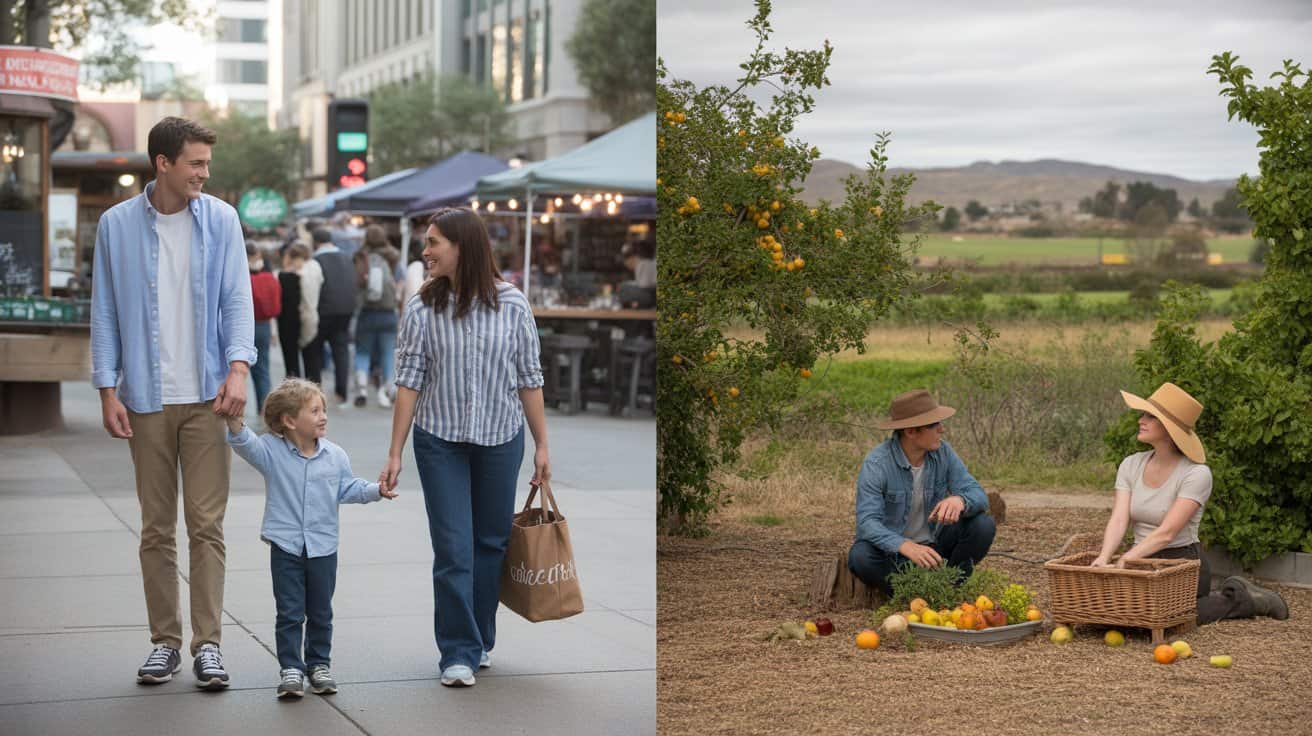
Your lifestyle influences whether rural or urban San Diego suits you. Urban San Marcos offers a dynamic environment with diverse dining, from farm-to-table restaurants to global cuisine. Cultural events, like Carlsbad’s Art Walk, and nightlife at breweries create vibrancy. Families enjoy community activities, such as beach days or farmers’ markets, fostering engagement.
Rural Bonsall prioritizes tranquility. Residents connect at events like the Bonsall Harvest Festival or through outdoor pursuits like hiking and horseback riding. Community life feels personal, with neighbors sharing resources or organizing volunteer efforts. Rural areas offer space for hobbies like gardening or livestock, unavailable in urban settings.
Urban diversity brings global perspectives, with Carlsbad hosting residents from over 50 countries. Rural Fallbrook, less diverse, fosters deep community ties, with schools and churches as social hubs. Noise levels differ: urban areas average 60-70 decibels from traffic, while rural areas stay below 50. A Carlsbad family shared, “The city’s energy suits our kids’ schedules, with parks nearby.” A Bonsall buyer noted, “The quiet lets us grow food.” Lifestyle differences between rural urban California guide your choice.
Job Market and Economic Opportunities
San Diego’s job market in rural vs urban California varies significantly. Urban Carlsbad thrives in biotech, tech, and hospitality, with firms like Thermo Fisher offering salaries averaging $90,000. San Marcos supports education and retail, bolstered by Cal State San Marcos. Urban jobs often include benefits like stock options, appealing to professionals. Real estate appreciates 5-7% annually, drawing investors.
Rural Fallbrook’s economy centers on agriculture, avocados and citrus, and small businesses, with salaries around $50,000. Job scarcity pushes some to commute or work remotely, supported by improving rural internet, 50-100 Mbps. Bonsall’s proximity to urban hubs allows hybrid work. Rural properties appreciate slower, 2-4%, but lower prices balance investment potential.
In 2024, urban unemployment stood at 3.5% vs. rural 4.2%. Urban areas attract young professionals, while rural areas suit retirees or remote workers. Investors note urban homes yield faster returns, but rural land banking gains traction as San Diego expands. San Diego’s economic diversity supports varied career and investment goals.
Commute and Transportation
Commuting shapes daily life in San Diego. Urban Carlsbad offers 20-30 minute drives to local jobs, but rush-hour traffic on I-5 adds 15 minutes. The Coaster train connects to downtown San Diego in 45 minutes, with fares at $5-$6. Bus routes reduce car reliance in urban areas.
Rural Fallbrook faces 45-60 minute commutes to hubs like Carlsbad or Escondido. Scenic roads like Highway 76 have less traffic, but public transit is scarce, buses every 1-2 hours. Most rural residents drive, with gas costs around $2,000 annually vs. urban $1,500 due to distance.
Urban infrastructure ensures paved roads and repairs, while rural roads may need private upkeep, $500-$1,000 yearly. Parking differs: urban areas charge $2-$5/hour downtown, while rural parking is free but sparse. Commuting in rural vs urban California impacts lifestyle and budget, requiring careful planning. Whether you’re interested in urban or rural settings, you can browse available properties in San Diego at Properties to find your perfect match.
Education and School Districts
Families prioritize education options in rural vs urban California. Urban San Marcos Unified School District serves 20,000 students, with schools like Mission Hills High scoring 8/10 on GreatSchools. Class sizes average 25:1, with robust Advanced Placement courses. Private schools and Cal State San Marcos enhance options.
Rural Fallbrook Union School District, with 5,000 students, scores 7/10. Schools like Fallbrook High offer 20:1 ratios, fostering personalized learning. Extracurriculars focus on agriculture and arts. Rural areas lack private school density, requiring 20-30 minute drives for alternatives.
Urban areas provide diverse paths, while rural schools emphasize community. Families weigh these based on children’s needs and proximity. A 2024 study showed 80% of San Marcos graduates pursue college, vs. 75% in Fallbrook, reflecting slight urban advantages.
Healthcare and Emergency Services
Healthcare access in rural vs urban California varies. Urban Carlsbad offers Tri-City Medical Center, a 400-bed hospital with 24/7 emergency care, reachable in 10 minutes. San Marcos has urgent care and specialists, with wait times averaging 15 minutes. Urban areas host 3-5 pharmacies per square mile.
Rural Fallbrook relies on Fallbrook Medical Center, a smaller facility with limited specialists. Major hospitals are 20-30 minutes away. Emergency response averages 10 minutes in urban areas but 12-15 in rural ones due to distance. Rural pharmacies are fewer, often one per town.
Wildfires pose rural risks, requiring evacuation plans. Urban areas face occasional flooding but benefit from faster coordination. Healthcare proximity is key for families and retirees planning their move.
Safety and Environmental Quality
Safety and crime rates in rural vs urban California influence choices. Urban San Marcos reports 2.5 incidents per 1,000 residents (2024 Sheriff data), with property crimes like theft most common. Police patrols and community watches enhance security. Rural Fallbrook’s rate is 1.8 per 1,000, with minor vandalism primarily.
Environmental quality in rural vs urban California differs. Rural Bonsall enjoys air quality indices of 20-30, cleaner than urban Carlsbad’s 40-50 from traffic emissions. Noise pollution in urban areas hits 60-70 decibels, while rural areas stay below 50. Rural wildfire risks require defensible space maintenance, $500-$1,000 yearly. Urban flooding is mitigated by drainage systems.
Zoning, Utilities, and Infrastructure
Zoning and utilities impact property use. Urban Carlsbad’s strict zoning limits lot splits, ensuring planned development. Utilities are reliable, high-speed internet at 1 Gbps and municipal water costs $200/month. Rural Bonsall’s flexible zoning allows expansions, ideal for investors, but septic systems, $5,000-$10,000 every 5-10 years, and well water, $2,000-$5,000 installation, add costs. Rural internet reaches 50-100 Mbps.
Urban roads are city-maintained, while rural roads may require private upkeep, $500-$1,000/year. Power outages are rare in urban areas but last 1-2 days in rural zones during storms. These factors require planning for buyers and investors.
Why Pick Our Real Estate Services? Your Success, Our Guarantee
Adam Kelley Real Estate brings over $4 billion in sales across 3,000+ transactions, ranking among the top 1% of agents nationwide. Our deep knowledge of San Diego’s neighborhoods, from Fallbrook’s ranches to Carlsbad’s condos, ensures tailored guidance. With 500+ five-star reviews, clients praise our transparent approach, like a Fallbrook buyer who valued our zoning expertise. Our certifications from the National Association of Realtors and community efforts, like supporting housing in Mexico, build trust. We provide accurate valuations and market insights, helping you navigate rural or urban buying with confidence.
FAQs on Rural vs. Urban Home Buying in San Diego
What’s the commute like in Carlsbad?
Carlsbad’s 25-minute commutes use I-5 or the Coaster. Rush hour peaks at 7-9 AM. Rural Fallbrook’s 45-minute drive trades time for tranquility.
How do school districts compare in Fallbrook vs. San Marcos?
San Marcos Unified, 8/10, has larger schools; Fallbrook Union, 7/10, offers smaller classes. Urban areas provide more private options.
What are zoning laws in Fallbrook?
Fallbrook’s flexible zoning supports expansions but requires septic/well maintenance. We clarify regulations to streamline your purchase.
How does healthcare access differ in rural vs. urban San Diego?
Urban Carlsbad offers hospitals within 10 minutes; rural Fallbrook’s clinics require 20-30 minute drives.
What are wildfire risks in rural San Diego?
Rural Bonsall faces higher wildfire risks, needing $500-$1,000 yearly for defensible space. Urban flooding is less frequent.
Additional Considerations for Rural Home Buying
Rural home buying involves unique factors. Water sources are critical, Fallbrook wells yield 5-20 gallons per minute, but drought risks require storage tanks, $2,000-$5,000. Septic systems need inspections every 3-5 years, $300-$500, and soil tests ensure drainage. Pest control addresses rodents or termites, $200-$400 annually. Buyers should check land use history for chemical contamination, impacting value. Local governance, like Fallbrook’s Community Planning Group, influences development. Private road maintenance costs $1,000-$3,000 yearly, shared among neighbors. Verify access rights to avoid disputes. Due diligence ensures a sound investment.
Additional Considerations for Urban Home Buying
Urban home buying has distinct factors. Carlsbad’s zoning restrictions limit additions, preserving aesthetics but constraining flexibility. Homeowners associations enforce rules, like paint colors, and fees fund amenities. Review bylaws to avoid surprises. Parking challenges, $2-$5/hour downtown, and limited condo guest spaces require planning. Noise from highways or events needs soundproofing, $1,000-$3,000. Urban buyers benefit from city utilities but face higher water rates during droughts. Proximity to Carlsbad’s 7 miles of coastline boosts value but increases competition, with homes selling in 10-20 days.
Financing Your Rural or Urban Home
Financing varies by area. Urban Carlsbad buyers qualify for conventional loans with 5-20% down, $62,500-$250,000 at $1.25M. FHA loans, 3.5% down, suit first-time buyers but have stricter appraisals. Rural Fallbrook buyers may use USDA loans, 0% down for incomes below $103,500. Interest rates in 2024 average 6.8% for 30-year fixed loans. Rural appraisals for septic or wells add $500-$1,000. Urban appraisals focus on comparable sales. Lenders scrutinize rural land use, ensuring zoning aligns with terms. Urban buyers need escalation clauses to win bids.
Real Estate Appreciation Trends
Appreciation guides investors. Urban Carlsbad homes gained 6.2% annually from 2020-2024, a $1M home now worth $1.27M. Rural Fallbrook saw 3.8% growth, $700K to $850K. Urban appreciation ties to tech growth and rail expansions. Rural growth depends on land availability and sprawl, Fallbrook’s I-15 proximity boosts potential. Rural investors hold properties for 10-20 years, while urban flips yield profits in 3-5 years. San Diego’s 5% county-wide appreciation outpaces inflation, making both viable.
To dive deeper into how you can strategically invest in California’s real estate market, check out our Ultimate Guide to Real Estate Investing in California.
Community Involvement and Local Governance
Community life in rural vs urban California shapes experiences. Urban Carlsbad’s city council oversees development, ensuring parks meet needs. Events like the Carlsbad Marathon foster engagement. Homeowners associations organize neighborhood activities. Rural Fallbrook’s Community Planning Group advises on zoning, giving residents a voice. The Avocado Festival draws thousands, building pride. Rural governance is less formal, with volunteer boards addressing roads or water. Urban areas offer structured programs, rural ones grassroots efforts. Attend meetings or festivals to gauge fit.
Environmental Considerations
Environmental factors impact livability. Urban Carlsbad faces air quality challenges, AQI 40-50, from emissions, mitigated by bike lanes. Coastal erosion risks require $10,000-$50,000 in fortifications. Rural Bonsall’s AQI of 20-30 supports healthier living, but wildfire risks demand $500-$1,000 yearly for brush clearing. Rural wells draw from strained aquifers, needing low-flow fixtures, $200-$500. San Diego’s 50% renewable energy goal by 2030 benefits both areas. Environmental planning aligns homes with sustainability.
Navigating the Home Buying Process
Buying requires preparation. Pre-approval secured loans within 30 days. Urban buyers offer 5-10% above asking, rural negotiations allow 2-5% below. Inspections, $400-$800, check urban foundations or rural wells. Title searches, $200-$400, confirm ownership. Urban closings take 30-45 days; rural ones extend to 60 for surveys. Escrow ensures smooth transfers. Visit neighborhoods at different times, urban evenings reveal noise, rural mornings show commutes. Request a Home Valuation to start your San Diego journey.
Making Your Decision with Confidence
Choosing between rural and urban San Diego depends on priorities. Families may favor Fallbrook’s affordable land and quiet schools, and professionals Carlsbad’s job proximity. Investors weigh urban appreciation against rural potential. Adam Kelley Real Estate, with $4 billion in sales, offers deep San Diego knowledge. Our top 1% ranking, 500+ five-star reviews, and community efforts, like housing initiatives in Mexico, reflect commitment. Schedule a Consultation with Adam Kelley to navigate your home buying journey.