
Choose a solo agent if you want one person handling every call, showing, and negotiation, and choose a real estate team if you want faster coverage, dedicated specialists, and backup when your lead agent is busy. Neither option is automatically better. The right answer depends on your timeline, your communication style, and how complicated your transaction is. If you are still early in the process, our complete guide to choosing a realtor in San Diego covers the full decision from start to finish.
This guide breaks down how each model works, what you gain and give up with each, how commissions are handled, and which situations tend to favor one approach over the other. By the end, you will have a simple way to decide with confidence, whether you are buying your first home, selling a long-held property, or relocating to Southern California.
Quick Answer: Solo Agent vs. Real Estate Team at a Glance
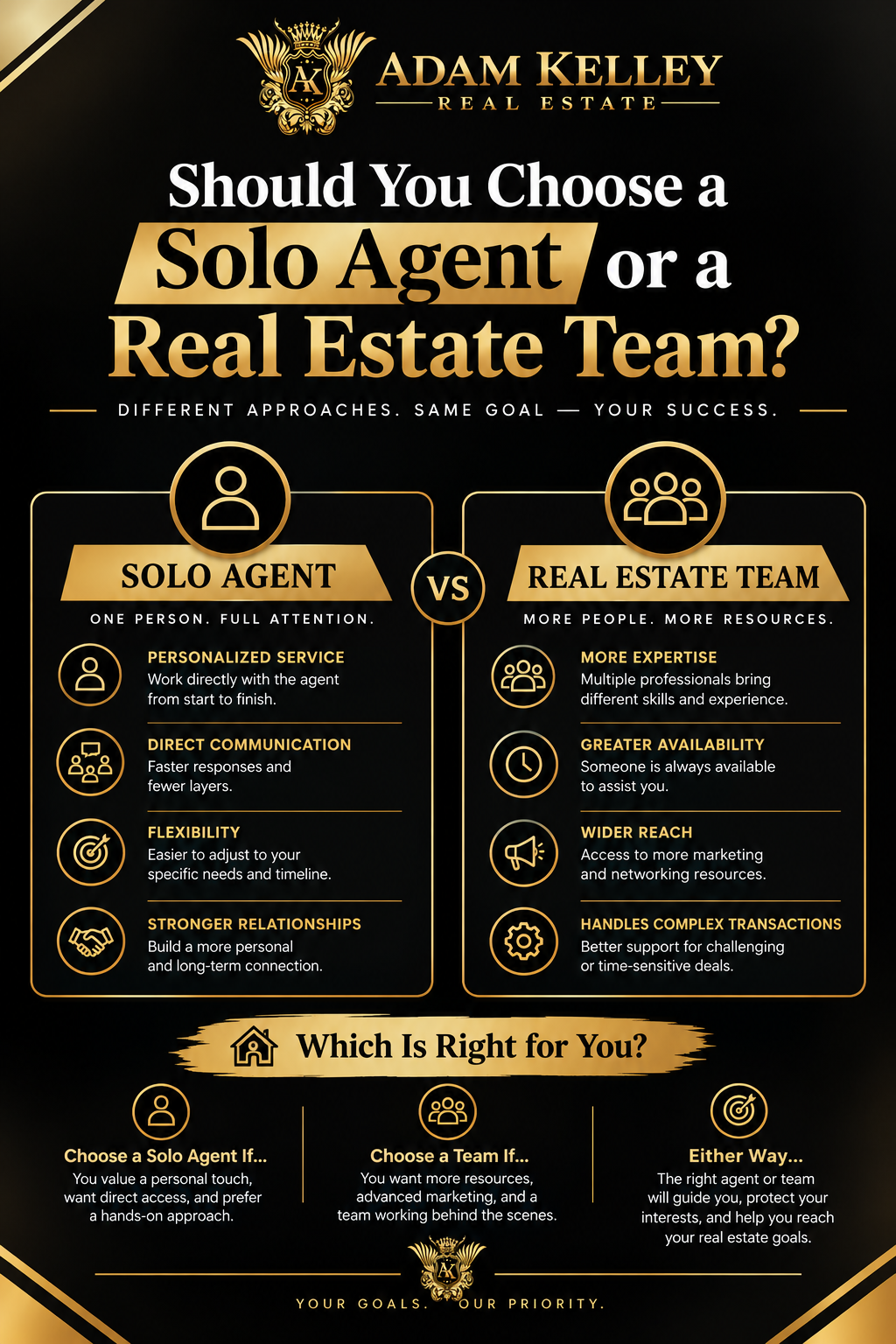
A solo agent offers direct, one-on-one service and a single point of accountability. A real estate team offers division of labor, broader availability, and specialized support staff. Commission rates are usually comparable, because a team typically splits the same fee internally rather than charging you more. If you are unsure where to begin, our article on how to choose the right real estate agent for your needs walks through the questions that matter most.
What Is a Solo Real Estate Agent?
A solo real estate agent is a licensed professional who runs their business largely on their own. They may have a part-time assistant or work under a larger brokerage, but you deal directly with them for almost every part of your transaction. They take the calls, schedule the showings, write the offers, negotiate, and manage the closing timeline. When you read about the top-rated real estate agents in San Diego, you will notice that many of the most respected names build their reputations on exactly this kind of personal service.
How a Solo Agent Typically Works
Because one person carries the entire workload, a solo agent usually limits the number of clients they take on at any given time. The best ones are selective, because they know their reputation depends on returning calls quickly and catching details before they become problems. Many solo agents lean heavily on trusted outside vendors such as photographers, stagers, inspectors, and title officers, which means the quality of those relationships matters. Understanding the difference between a licensed agent and a member of the national association also helps you vet any professional, which is why many buyers read up on how to choose a realtor before signing anything.
Pros of Working With a Solo Agent
There are real advantages to the one-person model, especially for clients who value relationship and consistency above everything else.
Direct Relationship From Start to Finish
You work with the exact person you hired, from the first consultation to the closing table. There are no handoffs to junior members or assistants, and you never have to re-explain your goals to someone new. If you want to see how a personal approach plays out in practice, our guide on how to choose a listing agent to sell your house shows what to expect from an agent who owns the whole process.
High Accountability
When one person manages every detail, there is no ambiguity about who is responsible. If a deadline is missed or a question goes unanswered, you know exactly who to talk to. That clarity lowers the risk of miscommunication, because information does not have to pass through several people before it reaches the person making decisions. This is one of the most common reasons buyers who read our advice on common mistakes when choosing an agent end up preferring a solo agent.
Personalized Focus and Strategy
Solo agents often build deep rapport with clients and tailor their strategy closely to personal timelines and goals. A first-time buyer who needs education at every step, or a seller with an emotional attachment to a family home, may value the patience and customization that come with one-on-one attention. That personal touch also helps when you are comparing neighborhoods, such as deciding between Carlsbad, Oceanside, and Escondido, where the right fit depends as much on lifestyle as on price.
Cons of Working With a Solo Agent
The same one-person structure that creates intimacy also creates limits. It is worth being honest about them before you commit.
Limited Availability
A single person cannot answer every call, host every open house, and draft every contract at the same time. If your agent is in the middle of another negotiation, on vacation, or sick, your question may sit unanswered for hours. In a fast-moving market, those hours can matter. Buyers who are racing to submit offers should understand where timing pressure shows up, which our realtor selection guide helps you plan for.
Slower Task Execution
Marketing, photography coordination, paperwork, showings, and negotiation all land on one person’s shoulders. During busy seasons, that workload can stretch response times and delay listing launches or document reviews. A well-organized solo agent will manage this with strong systems and vendor relationships, but you should ask directly how they handle peak periods. Sellers in particular should review how to choose a listing agent in San Diego so they know which questions to ask about marketing capacity.
Single Point of Failure
If your agent becomes unavailable at a critical moment, such as the week before closing, you may have no one to step in. Solo agents often arrange a backup agent for emergencies, but the quality of that coverage varies. Ask who covers for them and whether you will have a chance to meet that person in advance, and use the checklist in our guide to choosing the right agent to keep the conversation focused.
What Is a Real Estate Team?
A real estate team is a group of licensed agents and support professionals who work together under a shared brand, usually led by one or two rainmakers. Team members may include buyer’s agents, listing specialists, showing assistants, transaction coordinators, marketing managers, and client care coordinators. In larger markets like San Diego, teams have become common because they can handle high volumes while still offering structured service. If you are comparing individual agents and teams, our roundup of the top real estate agents in San Diego is a helpful starting point.
How Teams Are Typically Structured
Most teams follow one of a few patterns. In a rainmaker model, a lead agent generates business and hands clients to buyer’s agents or listing specialists who do most of the day-to-day work. In a partnership model, two or more equal agents share clients and responsibilities. In a specialist model, each member focuses on a narrow function such as listings, buyers, or investment properties. Knowing which structure you are dealing with is crucial, because it determines who will actually be answering your calls. We cover this idea in more depth in our article on how to choose the right real estate agent.
Pros of Working With a Real Estate Team
Teams exist because they solve a real problem: no single person can be everywhere at once. Here is where the team model shines.
Division of Labor
Teams feature dedicated roles such as transaction coordinators, marketing specialists, and showing assistants. That keeps your sale or purchase moving on multiple fronts at once. While one person schedules inspections, another can prepare listing photos, and a third can follow up on lender documents. For sellers who want maximum exposure quickly, the structure described in our guide to selling your home with the right listing agent pairs naturally with a team’s production capacity.
Better Coverage and Responsiveness
If your lead agent is busy in a negotiation or out of town, another team member is usually available to step in immediately for a showing or an urgent question. That backup is especially valuable for buyers who want to tour homes on short notice, or for out-of-area clients who need someone available across time zones. Anyone planning a long-distance move, such as those reading our relocation guide for moving to Escondido, often benefits from a team that can cover showings and video tours while they are still out of state.
Specialized Skills
Different team members handle the areas they do best, from staging consultation to contract review to closing coordination. Instead of one generalist stretching to cover everything, you get people who perform specific tasks repeatedly and know the common pitfalls. This is particularly useful for complex transactions such as investment purchases, probate sales, or rent-to-own arrangements in San Diego, where the details of the contract structure matter a great deal.
Systems and Consistency
Established teams tend to have documented processes: standard checklists, pre-built marketing templates, vendor lists, and communication schedules. That consistency can reduce the chance of dropped details and give you a predictable experience. If you value structure, ask to see the team’s workflow before you sign, and compare it against the criteria in our complete realtor guide.
Cons of Working With a Real Estate Team
The team model is not without trade-offs. Understanding them helps you ask better questions.
Risk of Miscommunication
Passing tasks between multiple people can occasionally cause details to slip through the cracks. A request you made to your lead agent may need to travel through two or three people before it is handled. The best teams minimize this with shared software and clear ownership of each task, but the risk is real. Our guide to choosing the right agent for your needs includes questions to help you test how a team communicates internally.
Less Personal Contact
You may deal with several different people throughout your buying or selling process rather than one consistent face. Some clients love the coverage; others feel they were sold by a star agent and then handed off to someone they barely know. Before you sign, ask exactly who your primary contact will be and how often you will hear from the lead agent directly, a point we also stress in our listing agent guide.
Variable Experience Levels
Not every team member has the same experience. A strong team will pair junior agents with seasoned mentors, but you should ask about the licensing history and transaction volume of the person who will actually represent you. If you are comparing agents by track record, our list of top San Diego agents shows what to look for in experience and reviews.
Does a Real Estate Team Cost More Than a Solo Agent?
In most cases, no. Hiring a team does not inherently cost more than hiring a solo agent. The total commission percentage is typically the same, and the team simply divides that fee internally among its members. What you are really paying for is the service level, not an extra layer of fees. Commission structures are negotiable and shaped by current market practices and agreements, so review any listing or buyer representation agreement carefully, and read our primer on what to expect when you hire a listing agent before you sign.
What to Ask About Fees
Regardless of which model you choose, ask these questions up front: What is the total commission, and who receives it? Are there administrative or transaction fees on top of the commission? What happens if I need to cancel the agreement? Does the fee change if I work with a different team member? A transparent professional will answer plainly and put everything in writing. For a deeper look at evaluating agent contracts, see our complete realtor selection guide.
Solo Agent vs. Team for Buyers
Buyers have different needs than sellers, and those needs often tilt the decision. If you are a first-time buyer, you may value a patient guide who will explain mortgage pre-approval, inspections, and escrow without rushing you. That favors a solo agent or a team with a clearly assigned lead who stays involved. If you are an experienced buyer moving quickly in a competitive market, you may prefer a team that can tour homes with you on short notice and prepare offers fast.
Location matters too. Buyers exploring several communities at once, such as coastal and inland North County, often need an agent with deep local knowledge in each area. Our comparison of Carlsbad, Oceanside, and Escondido is a good reminder that neighborhood expertise should be a top criterion regardless of whether the agent works alone or on a team.
When a Solo Agent Is Usually the Better Fit for Buyers
- You want hands-on education and one consistent advisor.
- You are buying in a single, well-defined area.
- Your timeline is flexible enough that a delayed response is not a problem.
- You prefer to build a long-term relationship for future transactions.
When a Team Is Usually the Better Fit for Buyers
- You are searching in a fast-moving market and need showings arranged quickly.
- You are relocating and need someone to cover tours while you are out of town.
- You want a lender, inspector, and transaction coordinator already lined up.
- Your schedule is tight and you want multiple points of contact.
For a realistic view of how to plan your purchase and vet your agent, review our article on how to choose a realtor.
Solo Agent vs. Team for Sellers
Sellers care about exposure, pricing strategy, presentation, and speed. A strong marketing machine can matter a great deal, which is why many sellers lean toward teams. Teams often have in-house or preferred photographers, stagers, copywriters, and social media support, plus a transaction coordinator who keeps the paperwork on schedule. If your home is complex, unusual, or in a competitive price tier, that production capacity can help.
That said, many sellers prefer a single trusted negotiator who knows their property intimately. A solo agent who attends every showing, answers every inquiry personally, and negotiates every counteroffer can be a powerful advocate, particularly when the home has unique features that need to be explained. For a closer look at what separates strong listing agents, see our guide on how to choose a listing agent to sell your house in San Diego.
Questions Sellers Should Ask Either Way
- How will you market my home, and who is responsible for each task?
- How many listings are you handling right now?
- Who will attend showings and answer buyer inquiries?
- What is your average list-to-sale price ratio and time on market?
- Who will I speak to if I have an urgent question after hours?
Sellers who want to understand how pricing and positioning interact can also compare notes with our guide to choosing the right real estate agent.
Which Is Right for You? A Simple Decision Framework
The cleanest way to decide is to rank what matters most to you. Start with the three factors below.
1. How Much Personal Attention Do You Want?
If you want to know the exact person handling every decision, a solo agent is the safer pick. If you are comfortable with a group as long as the work gets done, a team may suit you. Ask yourself whether you would feel uneasy if a junior member answered your questions instead of the lead agent, and review our realtor selection guide for ways to test that in an interview.
2. How Fast Do You Need to Move?
If you are on a tight timeline, need fast responses, or are buying and selling at the same time, a team’s parallel workflow can be a real advantage. If your timeline is flexible, a solo agent’s slower but more personal pace may be perfectly fine. Sellers on a deadline can use our listing agent guide to build a realistic launch plan.
3. How Complex Is Your Transaction?
Straightforward single-family purchases are manageable for most competent solo agents. Multi-property deals, investment purchases, relocations, and unusual contract structures often benefit from specialists. If your plans involve something less conventional, such as rent-to-own housing or moving from out of state, ask any agent or team how many similar deals they have closed.
Scenarios: Which Option Wins?
Sometimes the best way to decide is to picture your own situation. These common scenarios show how the choice tends to play out in a market like San Diego.
Scenario 1: First-Time Buyer Who Wants Guidance
A first-time buyer usually has lots of questions and benefits from steady, patient communication. A solo agent, or a team where you work primarily with one named agent, tends to be the better fit. Pair that with solid local knowledge, and you can navigate unfamiliar steps with confidence. If you are exploring areas before choosing, our North County comparison can help narrow your search.
Scenario 2: Seller Who Needs to Move Quickly
A seller with a job transfer or contingent purchase needs a fast, coordinated launch: staging, photography, pricing, and marketing all in a short window. A team’s division of labor is built for exactly this. Make sure the team can show you a clear launch timeline and name the person responsible for each step. Our article on choosing a listing agent lists what a strong launch plan should include.
Scenario 3: Out-of-Area Relocation
When you are buying from another state, availability and communication matter more than anything. A team can cover showings, send video walkthroughs, and respond across time zones. A solo agent can still do this well if they are highly organized and set clear expectations. Read our guide to moving to Escondido for an example of how much local context a relocating buyer needs.
Scenario 4: Seller With a Unique or Sentimental Property
A long-held family home or a one-of-a-kind property often benefits from a single advocate who takes time to learn its story. A solo agent can craft a tailored marketing narrative and negotiate personally. If you want to compare how top-rated professionals approach that kind of listing, browse our list of top San Diego real estate agents.
Red Flags to Watch For in Either Model
The label “solo” or “team” says nothing about quality. Regardless of structure, watch for these warning signs, and read our list of common realtor selection mistakes for more detail.
Red Flags With Solo Agents
- They take on far more clients than one person could reasonably serve.
- They have no backup plan for illness, travel, or emergencies.
- They are slow to return calls or messages during the interview stage.
- They cannot explain who handles tasks such as photography, paperwork, and inspections.
Red Flags With Teams
- You cannot find out who will actually represent you until after you sign.
- The lead agent disappears after the listing presentation.
- Team members give inconsistent answers to the same question.
- Contract terms or fees change depending on which team member you work with.
The Middle Ground: Boutique Teams and Solo Agents With Support
The choice is not always binary. Many professionals operate somewhere in the middle: a lead agent supported by a small group of assistants, a solo agent paired with a dedicated transaction coordinator, or a boutique team of two or three experienced agents. These hybrid models can deliver the personal attention of a solo agent along with some of the coverage and efficiency of a larger team.
When you interview a professional, ask them to describe their support structure plainly. Who answers the phone when they are in a meeting? Who handles contracts and deadlines? Who will show you homes if they are unavailable? The answers will tell you far more than the label on their business card. You can also use the vetting questions in our complete realtor guide to compare any hybrid setup.
Questions to Ask Before You Hire Anyone
Whether you choose a solo agent or a team, a short interview can reveal almost everything you need to know. Bring this list to every consultation.
- Who will be my main point of contact, and how often will I hear from the lead agent directly?
- Who handles showings, paperwork, and marketing?
- How many clients are you working with right now?
- What is your backup plan if you are unavailable?
- What is the total commission, and are there any additional fees?
- How many transactions have you closed in my neighborhood and price range?
- How quickly do you typically respond to calls and messages?
- Can I speak to recent clients about their experience?
For a deeper set of vetting questions tailored to San Diego, review our guide on choosing the right real estate agent.
Final Checklist: Solo Agent or Team?
Use this quick checklist after your interviews.
- Choose a solo agent if you want deep, direct, one-on-one communication and prefer knowing the exact person handling every decision.
- Choose a real estate team if you are on a tight timeline, need fast responses, or prefer a group with dedicated specialists managing marketing and paperwork behind the scenes.
- Choose a hybrid or boutique setup if you want a consistent lead agent with extra support behind the scenes.
- Walk away from anyone who cannot clearly explain who will do the work, what it will cost, and how you will be kept informed.
Still unsure? Compare a few professionals side by side using our guide to the top real estate agents in San Diego and book short consultations with two or three of them.
Final Thoughts: The Best Choice Is the One That Fits You
There is no universal winner in the solo agent vs. real estate team debate. A solo agent gives you direct access, high accountability, and a personal relationship. A team gives you coverage, speed, and specialized help. The best fit comes from matching the structure to your timeline, your communication style, and the complexity of your goals. Good agents exist in both models, and weak ones do too, so the person or group matters more than the label.
If you are buying or selling in San Diego County, take the time to interview your options, ask the hard questions, and get the details in writing. Visit Adam Kelley Real Estate to start a conversation about your goals, and use our realtor selection guide to prepare for your first meeting.
Frequently Asked Questions (FAQs)
Is a solo agent or a real estate team better?
Neither is better in every situation. A solo agent is usually better if you value one-on-one communication and a single point of accountability, while a real estate team is usually better if you need fast responses, round-the-clock coverage, and specialists handling marketing and paperwork. Your timeline and the complexity of your transaction should guide the decision. For help comparing professionals, see our guide to choosing the right real estate agent.
Does a real estate team charge more than a solo agent?
Usually not. The total commission percentage is typically the same, and a team divides the fee among its members. Always confirm the total commission and any additional fees in writing before you sign. Our article on hiring a listing agent explains what to look for in a listing agreement.
What are the main pros and cons of a solo real estate agent?
The main pros are a direct relationship, high accountability, and personalized focus. The main cons are limited availability and slower task execution when the agent’s workload is heavy. Ask any solo agent how they handle backup coverage and busy seasons. You can find more evaluation tips in our complete realtor guide.
What are the main pros and cons of a real estate team?
The main pros are division of labor, better coverage, and specialized skills. The main cons are the risk of miscommunication and less personal contact, since you may work with several people instead of one. Clarify who your primary contact will be before you sign. Our roundup of top San Diego agents shows how experienced professionals describe their service models.
Will I still work with the lead agent if I hire a team?
Not always. In some teams, the lead agent handles the listing presentation and negotiation, while other members manage day-to-day tasks. In others, the lead is involved throughout. Ask in the first meeting who will represent you at showings, inspections, and closing, and get that in writing. Our realtor selection guide includes interview questions that surface this quickly.
Which is better for first-time home buyers?
First-time buyers often benefit from a solo agent or a team with a clearly assigned lead who offers patient, consistent guidance. That said, a strong team can also work well if you want quick showings and extra administrative support. Exploring local options in advance, such as through our North County neighborhood comparison, will help you ask better questions.
Which is better if I need to sell my house fast?
A team is often better for a fast, coordinated launch because tasks like photography, staging, marketing, and paperwork can happen at the same time. However, a well-organized solo agent with strong vendor relationships can also move quickly. Ask both types of candidates for a written launch timeline, and review our listing agent guide for what it should include.
Which is better if I’m relocating to San Diego from out of state?
Relocating buyers often prefer teams for their availability and ability to cover showings and video tours across time zones. A highly responsive solo agent can work too, if expectations are set clearly from the start. Our Escondido relocation guide shows the kind of local detail a relocating buyer should expect from their agent.
Can I switch from a solo agent to a team, or the other way around?
Possibly, but it depends on your agreement. Review the cancellation terms in your representation or listing agreement before signing anything, and ask what happens if you are unhappy with the service. Reading about common realtor selection mistakes can help you avoid needing to switch in the first place.
How do I decide between a solo agent and a team in one sentence?
Choose a solo agent for personal, one-on-one service; choose a team for speed, coverage, and specialists; and choose either one only after confirming exactly who will do the work and what it will cost. For a full walkthrough, start with our guide to choosing a realtor.