How to Verify a Private Landlord in San Diego (2026)
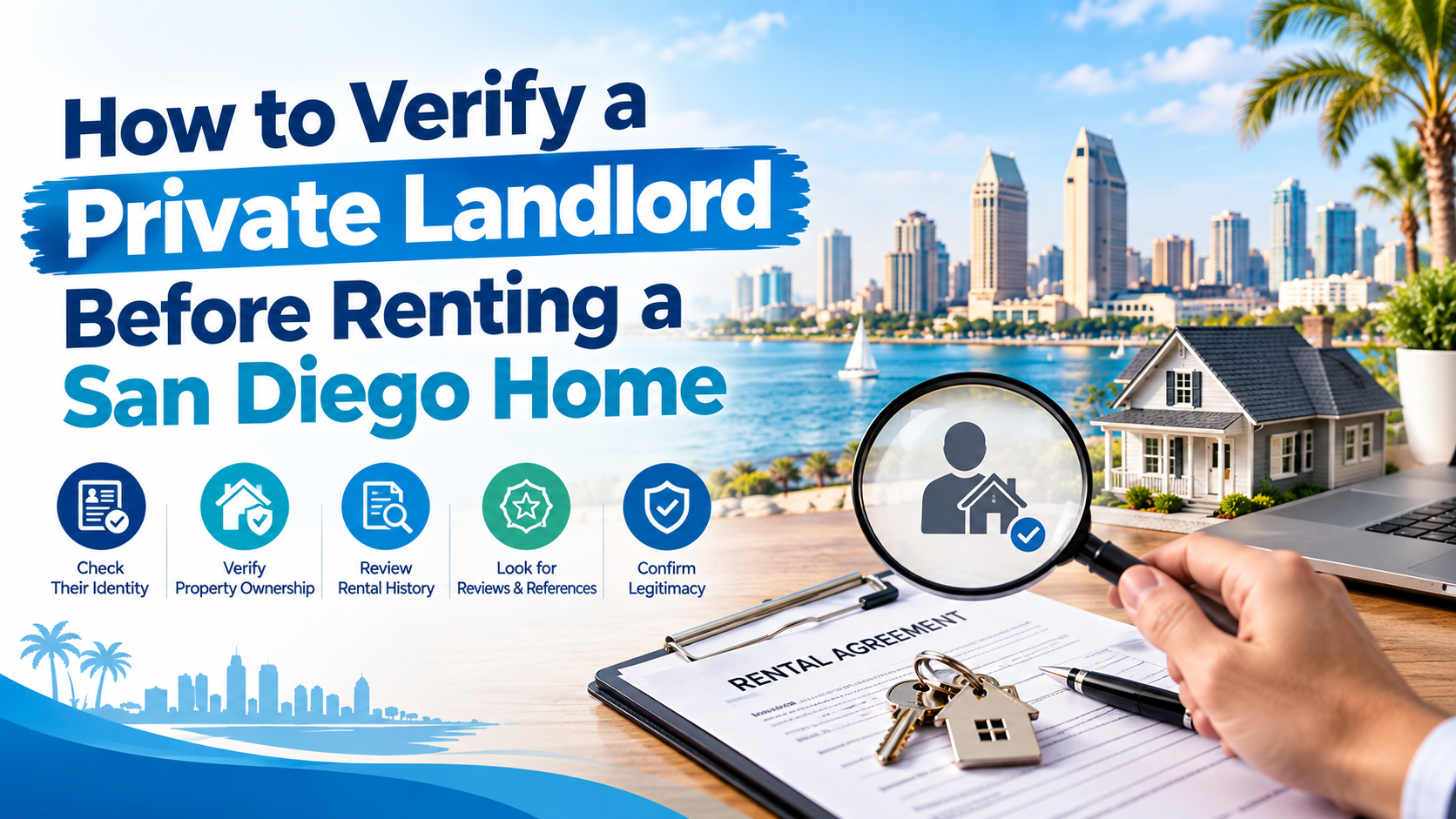
How to Verify a Private Landlord in San Diego (2026)
Quick answer: verify a private San Diego landlord by looking up the property’s recorded owner through the San Diego County Assessor, matching that name to the landlord’s photo ID, requesting a recent tax bill or utility statement, and never paying a deposit before touring the home in person or on a live video call. If a property manager is involved instead of the owner, confirm their license through the California Department of Real Estate before signing anything.
Renting directly from a private landlord in San Diego can mean lower fees, more flexible terms, and a faster path into a home than going through a large management company. It also means there’s no corporate name backing the listing — which is exactly what rental scammers count on. Nationally, the FTC has tracked nearly 65,000 reported rental scams since 2020, totaling roughly $65 million in losses, and separate FBI data put 2025 rental-fraud losses at over $275 million. San Diego’s tight, expensive rental market makes it a natural target for the same tactics.
This guide walks through exactly how to verify a private landlord in San Diego County, the California tenant protections you should know before you sign anything, the documents to ask for, and the red flags that should make you walk away. If you haven’t started your search yet, our guide on how to find private landlords in San Diego is a good place to start before you get to this step.
The Trade-Offs of Renting From a Private Landlord
Private rentals aren’t inherently riskier than renting through a management company — they just shift more of the responsibility onto you. Understanding the trade-off helps you know where to focus your verification effort.
- Lower fees: private landlords typically don’t tack on the administrative or portal fees common with larger management companies.
- More flexible terms: an individual owner can often negotiate move-in dates, minor lease terms, or a longer initial walkthrough more easily than a corporate leasing office.
- Direct communication: repairs and questions go straight to the person who knows the property, without routing through a call center.
- Less standardized screening: this cuts both ways — it can mean more flexibility for renters with an unusual situation, but also less consistency in how applications are handled.
- No corporate accountability layer: if something goes wrong, there’s no larger company brand or reputation at stake the way there is with an established management firm — which is exactly why the verification steps in this guide matter.
Why Verification Matters: Rental Scams Are Rising
Private rentals skip the layer of institutional screening that comes with a property management company, which is part of what makes them appealing — but it also means the responsibility for confirming legitimacy falls on you. According to the FTC’s most recent data spotlight, about half of reported rental scams in the year ending June 2025 started with a fake ad on Facebook, with Craigslist and other listing sites making up most of the rest. Scammers typically copy the photos and details from a real listing — sometimes even a home that’s actually for sale, not for rent — and repost it with their own contact information so inquiries reach them instead of the real owner.
Renters between 18 and 29 were three times more likely than other age groups to report losing money to a rental scam, often through college-focused Facebook groups and sublet listings. The median reported loss per FTC data is about $1,000 — real money to lose over a search that a few basic checks could have prevented.
California Tenant Protections You Should Know Before You Sign
Verifying the landlord is only half the picture. Knowing what California law actually allows helps you spot a lease that’s already out of bounds, which is its own kind of red flag.
Security Deposit Limits (AB 12)
As of July 1, 2024, most California landlords can charge a maximum security deposit of one month’s rent, regardless of whether the unit is furnished — a significant drop from the previous two- or three-month allowance. There’s a narrow exception: a “small landlord” who personally owns two or fewer rental properties totaling four or fewer units can still charge up to two months’ rent. If a private landlord is asking for more than one month’s deposit and doesn’t clearly qualify for that exception, ask them to explain why.
Rent Increase Caps (AB 1482)
Most California rental units built more than 15 years ago fall under the state’s Tenant Protection Act, which caps annual rent increases at 5% plus the local rate of inflation, up to a hard ceiling of 10% per year, and limits increases to no more than twice in any 12-month period. Newer construction and some single-family homes are exempt, but it’s worth asking which category your rental falls into before you sign a lease with vague renewal terms.
Move-In and Move-Out Documentation
Recent state law changes also require landlords to document unit and appliance condition with time-stamped photos at move-in and move-out, and to return any deposit balance, with an itemized statement, within 21 days of move-out. A landlord who resists a written move-in inspection or refuses to document the unit’s condition is skipping a step the law expects them to follow.
Habitability: What a Landlord Must Provide
Separate from deposit and fee rules, California’s implied warranty of habitability requires landlords to keep a rental unit fit to live in — functioning plumbing, heating, weatherproofing, working locks, and freedom from serious pest or mold problems, among other basics. A landlord who is evasive about a unit’s condition before you’ve signed, or who describes ongoing issues as “not a big deal,” is worth pressing for specifics or a written disclosure before you commit.
Application and Screening Fee Limits
California also caps what a landlord can charge just to apply. As of 2026, the maximum rental application and screening fee is $65.86 per applicant, adjusted annually for inflation, and a landlord can only charge this if they’re actively screening you — the fee is meant to cover the real cost of a credit or background check, not to function as a general fee for interest in the unit. You’re entitled to an itemized receipt on request, and if no screening is actually performed, any unused portion must be refunded.
Fair Housing Protections
Federal and California fair housing law prohibit a landlord from refusing to rent, setting different terms, or asking different questions based on race, religion, national origin, disability, familial status, sex, gender identity, sexual orientation, source of income (including housing vouchers), or several other protected categories. A legitimate landlord’s screening criteria should be applied the same way to every applicant. Inconsistent or unusually personal questions unrelated to your ability to pay rent are worth noting alongside any other red flags.
Step 1: Confirm Property Ownership Records
The single most reliable verification step is checking who actually owns the property. San Diego County property ownership and tax records are public information, and checking them takes only a few minutes.
Check County Assessor and Tax Records
You can look up a property’s recorded owner name through the San Diego County Assessor’s public parcel records, or confirm the current tax bill through the County Treasurer-Tax Collector’s office. Search by the rental’s street address to pull up the parcel number and owner-of-record name. Compare that name with the name and ID the person presenting themselves as your landlord has given you. If the names don’t match, ask why — there are legitimate reasons (a recent sale, a living trust, an inherited property), but it’s worth getting a straight, verifiable answer before moving forward.
What to Do If the Property Is Owned by an LLC
A large share of San Diego rental properties are held under an LLC or business entity rather than an individual’s name, which is normal and not a red flag by itself — many owners use an LLC for liability protection. In this case, search the California Secretary of State’s business filing portal to see who is listed as the LLC’s registered agent or managing member. Ask your prospective landlord to explain their relationship to the entity — owner, managing member, or hired property manager — and confirm it matches what the business filing shows.
Step 2: Match the Landlord’s ID to Ownership Documents
Once you have a name from the public record, ask to see a government-issued photo ID from the person you’re renting from. The name should match the ownership record, or the person should be able to clearly explain their authority to lease the property on the owner’s behalf — for example, a property manager with a signed management agreement, or an adult child managing a parent’s rental. A landlord unwilling to show ID or answer basic questions about ownership is a meaningful warning sign, not a minor inconvenience to wave off.
Step 3: Ask for Proof Before You Pay Anything
Beyond the county record, a legitimate landlord can typically produce recent paperwork tied to the property:
- A current property tax statement showing their name and the rental address
- A recent utility bill in their name at that address
- A mortgage statement or HOA correspondence for the property
None of these need to be shared in full — even a partial view during an in-person meeting is enough to confirm the paperwork exists and lines up with what the county record shows.
Step 4: Recognize Common Rental Scam Red Flags
Most San Diego rental scams follow one of a few patterns. Knowing them in advance makes them much easier to spot in the moment.
The Copied or “Phantom” Listing
Scammers frequently copy an existing legitimate listing — sometimes even one for a home that’s actually for sale — strip out the real contact information, and repost it elsewhere with their own. A quick search of the property address online can surface the original listing, often with a different price or a different contact name, which is one of the clearest signs something is off.
Pressure to Pay Before You’ve Seen the Home
Never send a deposit or application fee based on photos alone or a scripted video call. Insist on an in-person tour or a live, unscripted video walkthrough where you can ask the “landlord” to show specific rooms in real time, on request.
Untraceable Payment Requests
Pay by check, a verified online rental portal, or credit card — all of which leave a paper trail. Treat any request for wire transfers, cryptocurrency, gift cards, or cash-only deposits as a hard stop.
Pricing Well Below Comparable Units
A price that’s noticeably lower than similar listings nearby is one of the most consistent scam signals in FTC data. If a deal looks unusually good for the neighborhood, treat that as a reason to verify harder, not a reason to move faster.
Urgency, Pressure, and Requests for Sensitive Information
Claims that “several other renters are interested” and that you must decide or pay within hours are a pressure tactic, not a normal leasing timeline. Be equally cautious with requests to submit a Social Security number, driver’s license copy, or pay stubs through an unverified link before you’ve confirmed the landlord is legitimate — some scams exist purely to harvest personal information rather than collect a deposit.
Landlord Conveniently “Out of the Country”
A common excuse for why the landlord can’t meet in person, can’t accept traceable payment, or needs you to handle logistics through a third party. Legitimate owners can almost always arrange a video call or send someone local to meet you.
Step 5: Verify Property Managers and Licensing
If a third party is managing the property rather than the owner renting it directly, California law is specific here: anyone who leases, rents, or collects rent on behalf of a property owner for compensation is generally required to hold a California real estate broker license (or work as a licensed salesperson under a supervising broker), under Business and Professions Code Sections 10130–10131.01. Operating without one is unlawful, and tenants have grounds to push back if a manager turns out to be unlicensed. You can confirm license status through the California Department of Real Estate’s public license lookup before signing anything or paying a fee.
The Complete Pre-Lease Verification Checklist
Use this as a working list before you tour, and again before you sign.
Before You Tour
- Search the property address online to check for duplicate or conflicting listings
- Look up the recorded owner in San Diego County Assessor records
- Note whether the owner is an individual or an LLC, and search the CA Secretary of State portal if it’s an LLC
Before You Pay Anything
- Tour the home in person or via live, unscripted video
- Ask to see the landlord’s or manager’s government-issued photo ID
- Request a recent tax bill, utility statement, or mortgage/HOA document tied to the property
- If a property manager is involved, verify their DRE license status
- Confirm the security deposit doesn’t exceed one month’s rent (unless the small-landlord exception clearly applies)
- Use only traceable payment methods — check, verified portal, or credit card
Verification Step Why It Matters Look up the property owner in county assessor records Confirms who legally owns the property Match landlord’s ID to the ownership record Confirms you’re dealing with the actual owner or an authorized agent Ask for a recent tax bill or utility statement Provides a second, independent proof point Tour the home in person or via live video Confirms the property exists and matches the listing Confirm deposit is capped at one month’s rent (AB 12) Flags leases that already violate state law Use traceable payment methods only Protects your deposit if something goes wrong Check DRE license if a property manager is involved Confirms legal authority to manage and lease the property
What to Do If You Suspect a Scam
If a listing fails more than one of the checks above, stop the process rather than rationalizing it.
- Report the listing to the platform it appeared on (Facebook, Craigslist, Zillow, etc.)
- File a report with the FTC at reportfraud.ftc.gov
- If you’ve already sent money, contact your bank or payment provider immediately — the faster you act, the better your odds of recovering funds
- Consider filing a police report if you’ve lost money or shared sensitive personal information
It’s always safer to lose a few days restarting your search than to lose a deposit — or your identity — to a listing that never existed.
Private Landlord vs. Property Management
| Comparison | Private Landlord | Property Management Company |
|---|---|---|
| Screening | Varies by owner; often more flexible | Standardized, often stricter |
| Verification Burden | Falls mostly on the renter | Company is licensed and identifiable |
| Flexibility on Terms | Often more negotiable | Usually fixed, standardized leases |
| Response Time on Repairs | Can be faster or slower, owner-dependent | Usually has a maintenance system in place |
| Fees | Typically lower | May include admin or portal fees |
Renting Privately in North County San Diego
Private rentals are common throughout North County, and the verification steps above are identical wherever the property is located — only the local market conditions shift, and those conditions affect which red flags matter most.
Carlsbad and Oceanside
Coastal cities like Carlsbad and Oceanside tend to have tighter rental inventory and higher average rents than inland areas, which makes an unusually cheap coastal listing especially worth double-checking against the ownership record and comparable rents nearby before you engage further.
Escondido and Bonsall
Inland communities like Escondido and Bonsall have more single-family and rural rental stock, where ownership sometimes sits under a family trust, an inherited estate, or an LLC rather than an individual. None of that is inherently a problem, but it’s exactly the situation where the Secretary of State business search and a direct conversation about the owner’s relationship to the entity are worth the extra few minutes.
When Renting Privately Stops Making Sense
If you’re going through this level of due diligence on every rental application, it may be worth running the numbers on buying instead. Our comparison of buying vs. renting in San Diego breaks down the long-term math, and rent-to-own homes in San Diego is worth a look if you like a specific property but aren’t ready to buy outright yet.
Where to Find Legitimate Private Landlords in San Diego
For a full breakdown of where to search and how to spot legitimate listings from the start — before you even get to the verification stage — see our practical guide to finding private landlords.
Frequently Asked Questions
How do I find out who owns a rental property in San Diego?
Search the property address through the San Diego County Assessor’s public parcel records, or request a current tax bill from the County Treasurer-Tax Collector’s office. Both show the recorded legal owner.
Is it a red flag if my landlord’s property is owned by an LLC?
Not by itself. Many San Diego rental properties are held under an LLC for liability and tax reasons. Ask how the person you’re dealing with is connected to the LLC and, if needed, confirm through the California Secretary of State’s business search.
What payment methods are safest when renting from a private landlord?
Checks, verified online rental payment portals, and credit cards all leave a paper trail. Avoid wire transfers, cryptocurrency, gift cards, or cash requested before you’ve toured the property.
Should I ever send a deposit before seeing the property?
No. Always tour the home in person or via an unscripted live video call before sending any money, no matter how convincing the listing photos are.
How much can a private landlord charge for a security deposit in California?
Under AB 12, most landlords can charge no more than one month’s rent as a security deposit, regardless of whether the unit is furnished. A narrow exception allows up to two months for a “small landlord” who owns two or fewer properties totaling four or fewer units.
How do I check if a property manager is licensed in California?
Use the California Department of Real Estate’s public license lookup to confirm an individual’s or brokerage’s license status before signing a lease or paying any fee through them.
How common are rental scams?
The FTC has tracked nearly 65,000 reported rental scams since 2020, totaling about $65 million in losses, with roughly half of recent reports originating from fake listings on Facebook. Renters ages 18–29 are three times more likely than other adults to report losing money to one.
What should I do if I think I’ve been scammed?
Stop all payment immediately, report the listing to the platform it appeared on, file a report with the FTC at reportfraud.ftc.gov, and contact your bank right away if you’ve already sent money.
How much can a landlord charge for an application or screening fee in California?
As of 2026, the maximum is $65.86 per applicant, and it must reflect the landlord’s actual out-of-pocket screening costs rather than a flat fee for interest in the unit. You can request an itemized receipt.
Can a landlord ask about my immigration status or source of income?
California fair housing law bars landlords from discriminating based on source of income, including housing vouchers, along with race, religion, national origin, disability, familial status, and other protected categories. Screening criteria should be applied consistently to every applicant.
Still Deciding Between Renting and Buying?
Verifying a private landlord is worth the extra effort, but if you’re weighing whether it’s time to stop renting altogether, Adam Kelley works with San Diego renters and first-time buyers to figure out what actually fits their budget and timeline. Browse current San Diego properties or reach out through adamkelleyrealestate.com to talk through your options.

Adil Imran
Recent Posts

Realtor Choosing Mistakes: 10 Costly Errors to Avoid When Hiring a Real Estate Agent

How Much House Can I Afford in San Diego? 2026 Guide