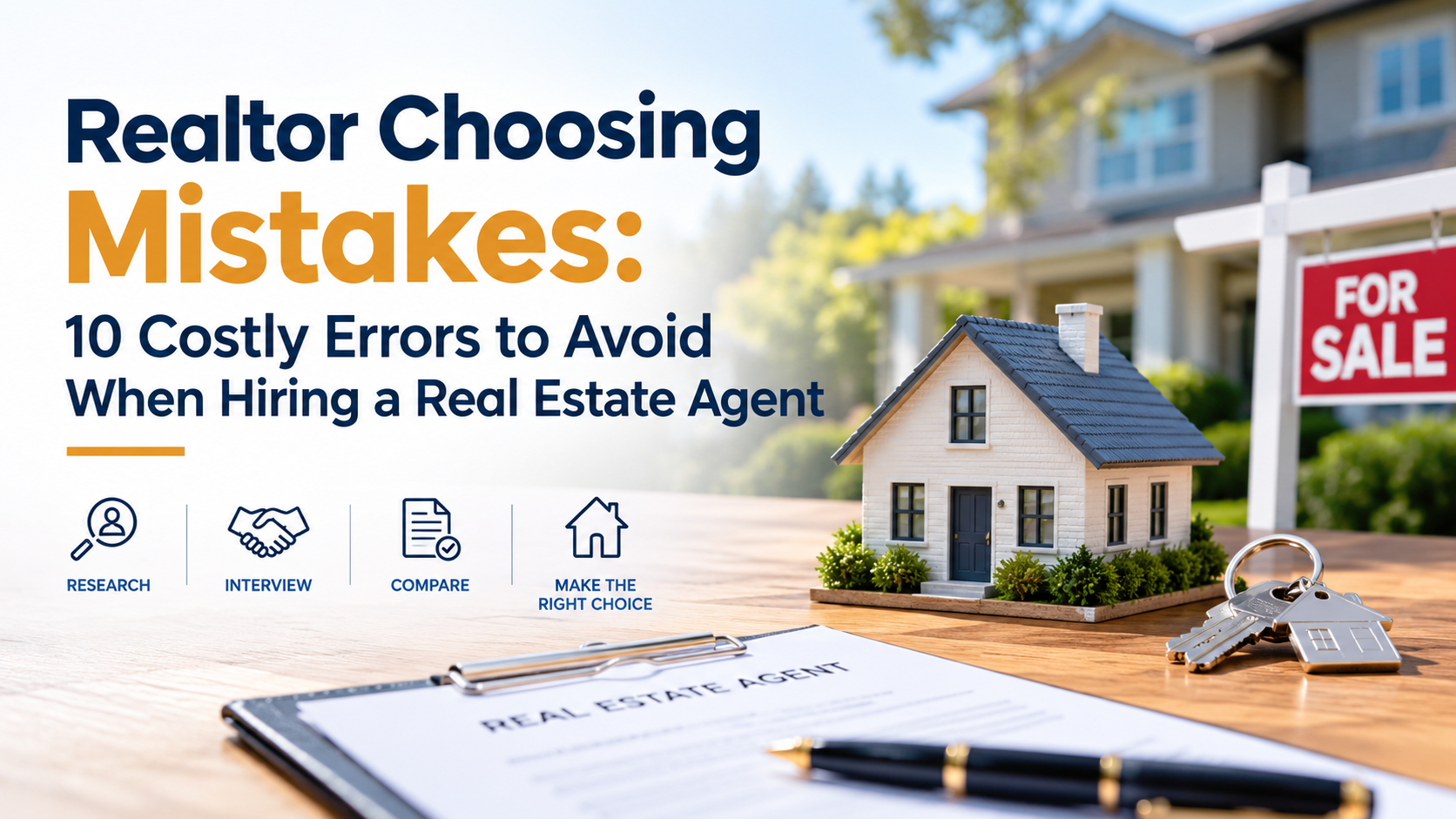
The most common realtor choosing mistakes are hiring a friend or relative out of obligation, picking the agent who promises the highest price or charges the lowest commission, skipping interviews and references, hiring a part-time or inexperienced agent, ignoring local market expertise, and signing an agreement without reading it. Avoiding these ten errors is the fastest way to learn how to choose a realtor who protects your money, your timeline, and your peace of mind.
Buying or selling a home is usually the largest financial transaction of your life, and the agent you hire steers nearly every decision along the way: price, marketing, negotiation, and contract deadlines. The wrong choice can cost you thousands of dollars, stretch your timeline by months, and add stress you never needed. This guide covers the ten most damaging mistakes, the realtor red flags that give them away, and the questions to ask a realtor before you sign anything.
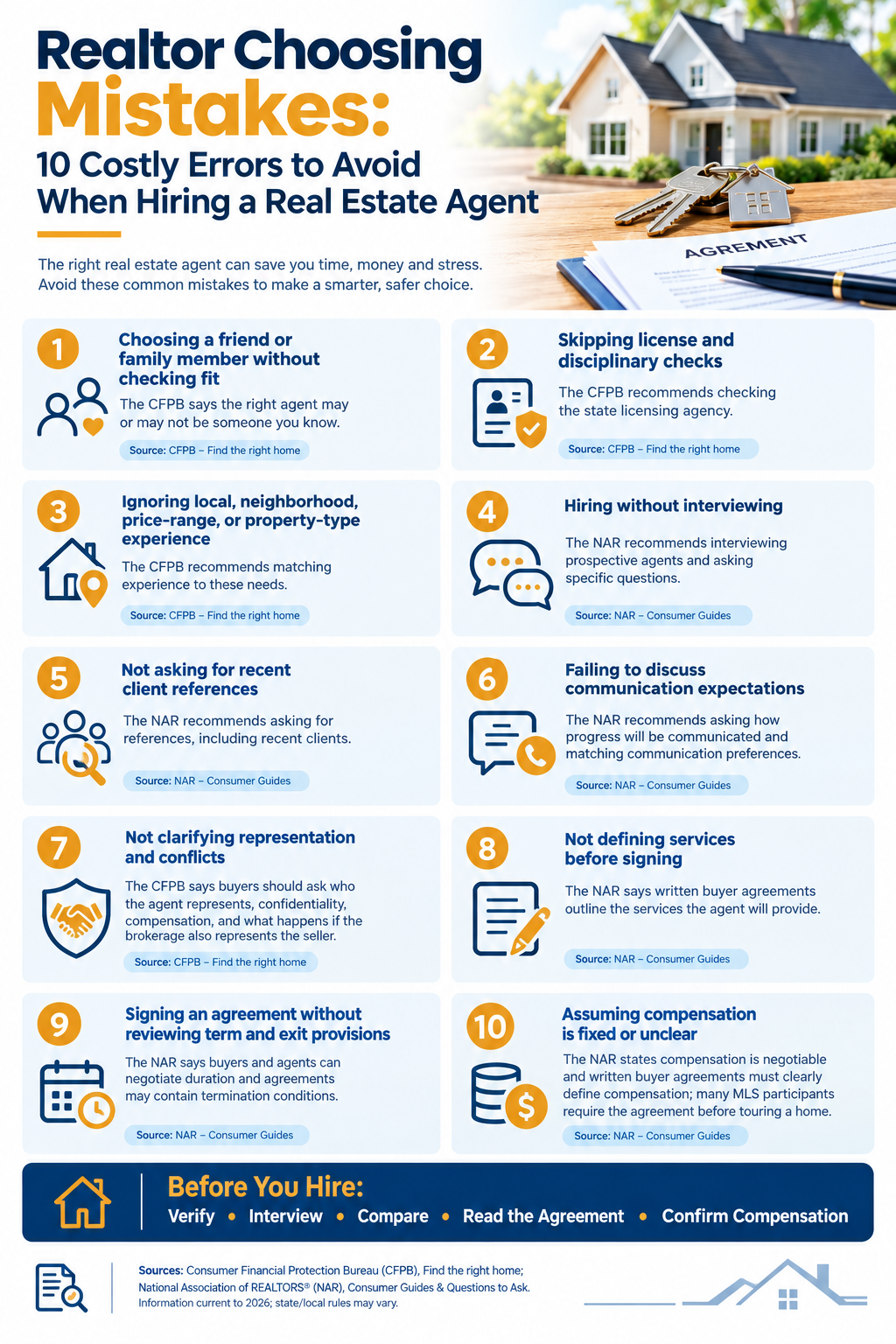
The 10 Mistakes at a Glance
- Hiring a friend or family member out of obligation
- Falling for the agent who quotes the highest price
- Choosing purely on the lowest commission
- Hiring a “yes person” who only tells you what you want to hear
- Skipping interviews and references
- Hiring a part-time or inexperienced agent
- Ignoring local market expertise
- Not verifying license and disciplinary history
- Signing an agreement without reading the fine print
- Overlooking communication style and who actually does the work
Why Choosing the Right Realtor Matters
Choosing the right real estate agent matters because your agent is your advisor, negotiator, and legal guardrail in a deal where small errors carry large price tags. A strong agent prices your home accurately, markets it to the right buyers, catches problems in contracts and disclosures, and negotiates from experience. A weak one can leave money on the table without you ever realizing it.
It also helps to know the vocabulary. A real estate agent is anyone holding an active state license to help people buy or sell property. A REALTOR® is a licensed agent who is also a member of the National Association of REALTORS® and agrees to follow its Code of Ethics. Every Realtor is an agent, but not every agent is a Realtor. Neither title, on its own, tells you whether a person is good at the job, which is why the process you use to choose matters more than the label on the business card.
10 Realtor Choosing Mistakes to Avoid
Mistake 1: Hiring a Friend or Family Member Out of Obligation
It feels awkward to hand your listing to a stranger when your cousin, neighbor, or college roommate just earned a license. That discomfort is exactly why so many people make this mistake. When the person representing you is also someone you will see at every holiday, it becomes harder to question their pricing advice, push back on a weak marketing plan, or replace them if things go wrong. You may also hold them to a lower standard than you would a professional you had interviewed.
A real estate transaction is a business decision with tens or hundreds of thousands of dollars at stake. Friends and relatives can make excellent agents, but only if they earn the job the way anyone else would: with local experience, a clear plan, and a track record you can verify. A true professional will welcome that scrutiny. If a friend gets offended when you interview other agents, treat that as useful information about how the working relationship would go.
How to avoid it:
Interview the friend or relative alongside two other agents and score everyone on the same criteria.
Mistake 2: Falling for the Agent Who Quotes the Highest Price
Industry insiders call it “buying a listing.” An agent tells you your home is worth far more than the data supports because they know an inflated number is the quickest way to win your signature. It is flattering, and it is a trap. Overpriced homes tend to sit, collect price reductions, and pick up the stigma of being stale. By the time you drop to the price you should have started with, you have lost the most valuable weeks of buyer attention and often end up selling for less than a correctly priced home would have.
In San Diego County, values can change noticeably from one neighborhood to the next, and even from one street to the next. A trustworthy price recommendation rests on recent closed sales of comparable homes nearby, not on asking prices, not on a national online estimate, and not on what the agent thinks you want to hear. Look for adjustments for condition, lot size, and upgrades, and for a candid explanation of where your home sits in the current market.
How to avoid it: Ask every agent to show the comparable sales behind their number. If one agent is far above the others and cannot explain why in plain language, that gap is your answer.
Mistake 3: Choosing Purely on the Lowest Commission
Commission is always negotiable, and since the August 2024 NAR settlement changes, compensation must be discussed openly and written into your agreement. Negotiating is smart. Choosing an agent only because their fee is the lowest is where people get into trouble. Agents typically fund listing marketing themselves: professional photography, video, floor plans, advertising, signage, and staging advice. An agent working on a rock-bottom fee has less room to invest in the exposure that brings competing offers.
Consider the math. On a $1,000,000 sale, a half-percentage-point difference in commission is $5,000. A sale price that lands just 2 percent higher because of better pricing, presentation, and negotiation is $20,000. The commission line is only one part of your net result, and rarely the biggest one. That does not mean the highest fee buys the best service either. What matters is the value delivered for the fee.
How to avoid it: Compare agents on expected net proceeds and the specific services included, not on the commission percentage alone.
Mistake 4: Hiring a “Yes Person” Who Only Tells You What You Want to Hear
Some agents agree with everything: your price, your timeline, your opinion that the outdated kitchen “won’t matter.” Others lean on catchy market slogans, like “marry the house, date the rate,” instead of giving you realistic advice about your situation. Agreeable is pleasant during the interview and expensive during the transaction.
You need an advisor who will give honest feedback about necessary repairs, pricing constraints, weak offers, and local market realities, even when it is not what you were hoping to hear. Good agents deliver hard news respectfully and back it with data.
How to avoid it: Ask each agent, “What is one thing about my home or my plan that could hurt me?” A confident professional will answer directly. A yes person will dodge.
Mistake 5: Skipping Interviews and References
Many buyers and sellers hire the first agent they speak with, often the one who answered the phone quickest or sent the flashiest mailer. Treat the decision like hiring for a critical job, because that is what it is. Interview at least two to three agents, ask for references from recent clients, and verify their track record in your specific neighborhood and price range. An agent who sells mostly condos may not be the best fit for a single-family home in a coastal community, and the reverse is also true.
Be cautious about relying solely on third-party websites where agents can pay for “premier,” “top agent,” or “best of” placement. Paid badges are advertising, not endorsements. Read reviews across several platforms and look for patterns in what past clients say about communication and follow-through.
How to avoid it: Request contact details for three clients from the past 12 months and actually call them.
Mistake 6: Hiring a Part-Time or Inexperienced Agent
Real estate is negotiation-heavy and deadline-driven. Contracts contain contingency periods measured in days, disclosures with legal weight, and moving parts that involve lenders, appraisers, inspectors, and escrow officers. A part-time agent may be unreachable during business hours when a buyer’s agent calls with an offer. An inexperienced agent may misjudge a buyer’s qualifications, miss a deadline, or accept unfavorable terms too quickly because they have not seen the situation before.
New agents are not automatically a bad choice, especially when they work under a strong mentor or team. The point is to know what you are getting. Ask how many transactions the agent closed in the past year, whether real estate is their full-time career, and who covers for them when they are on vacation or with another client.
How to avoid it: Ask for closed-transaction numbers from the last 12 months, and ask how many were in your area and price range.
Mistake 7: Ignoring Local Market Expertise
Hiring an agent because they are a friend of a friend, or because they work at a familiar national brand, can backfire when they do not know your market. San Diego County is not one market. A coastal neighborhood, a master-planned community inland, and a hillside area near a canyon can each behave differently in pricing, buyer demand, days on market, homeowners association rules, and special taxes such as Mello-Roos in some newer communities.
Local expertise shows up in the details: which streets buyers pay a premium for, how long comparable homes actually took to sell, and what inspectors commonly flag in homes of a certain age. That knowledge is difficult to fake.
How to avoid it: Ask for recent sales within about a mile of your home or target neighborhood, and listen for specifics rather than generalities.
Mistake 8: Not Verifying License and Disciplinary History
It takes two minutes and it is free, yet most people skip it. In California, the Department of Real Estate (DRE) offers an online license lookup where you can confirm that an agent or broker holds an active license, see which brokerage they work under, check the expiration date, and review any public disciplinary actions. A license that has lapsed, or a history of complaints, should end the conversation quickly.
If an agent advertises Realtor membership, awards, or special designations, confirm those too. Credentials only matter when they are real, current, and relevant to your type of transaction.
How to avoid it: Search each finalist by name and license number in the DRE lookup before the interview, not after.
Mistake 9: Signing an Agreement Without Reading the Fine Print
The agreement you sign, whether a listing agreement for a seller or a buyer representation agreement for a buyer, is a binding contract. Since the August 2024 NAR settlement changes, buyers working with agents who participate in the MLS are generally asked to sign a written agreement before touring homes, and that agreement should state how the agent will be paid. Sellers sign listing agreements that set the term, the price strategy, and compensation.
Before you sign, read for these items: the length of the agreement, whether it is exclusive, how compensation is calculated and who pays it, what happens if you want to cancel, and whether a “protection period” would obligate you to pay after the agreement ends. Do not feel pressured to commit to a long exclusive term with someone you met last week. Ask about shorter terms or a clear cancellation clause, and get any promises in writing. If something is unclear, ask a real estate attorney; this guide is educational, not legal advice.
How to avoid it: Ask for a copy of the agreement before your meeting so you can read it without a pen in your hand.
Mistake 10: Overlooking Communication Style and Who Actually Does the Work
Poor communication is one of the most common reasons clients feel let down by their agent. Some top-producing agents are impressive on the listing presentation, then pass you to an assistant or junior team member the moment you sign. Teams can be excellent, but you should know exactly who will attend showings and inspections, who negotiates on your behalf, and who answers when you have a question at 7 p.m.
Communication style matters too. Do you want quick texts or scheduled calls, weekly updates or a message only when something changes? Notice how quickly an agent responds while you are still just a prospect. That is usually the best they will ever be.
How to avoid it: Ask, “Who will I be speaking with day to day, and how fast do you usually respond?” Then ask to hear it from their past clients too.
Realtor Red Flags to Watch For
Realtor red flags often appear before you sign anything. Watch for these warning signs during your research and interviews:
- A price recommendation far above every other agent, with no comparable sales to back it up.
- Pressure to sign immediately, or a “this offer expires today” tone.
- Vague answers about recent sales, experience, or marketing plans.
- Reluctance to provide references or to show their license number.
- Guarantees about sale price or timing that no honest agent can promise.
- Slow or inconsistent responses before you have even hired them.
- A marketing plan that is generic, with no specifics about photography, online exposure, or open house strategy.
- Badmouthing competitors instead of explaining their own process.
- Unwillingness to discuss compensation, fees, or contract terms openly.
- Little knowledge of your neighborhood, or a plan that could apply to any home anywhere.
Green Flags vs. Red Flags at a Glance
| What to Evaluate | Green Flag | Red Flag |
|---|---|---|
| Pricing advice | Backed by recent closed comps and clear adjustments | Highest number with no data |
| Experience | Steady recent sales in your area and price range | Few or no recent transactions nearby |
| Communication | Fast, clear, in your preferred style | Slow replies or hand-offs to unnamed staff |
| Honesty | Explains risks and trade-offs, even unwelcome ones | Agrees with everything you say |
| Paperwork | Explains every term and welcomes questions | Rushes you to sign |
| Credentials | Active DRE license, verifiable reviews and references | Paid badges only, no verifiable track record |
Questions to Ask a Realtor Before You Hire
The best defense against every mistake above is a consistent interview. Ask each finalist the same questions and compare their answers side by side. Here are the questions to ask a realtor, grouped by what they reveal.
Experience and Track Record
- How many homes did you close in the last 12 months, and how many were in my area and price range?
- Are you a full-time agent, and do you work alone or with a team?
- What is your average list-to-sale price ratio and average days on market?
- Can I speak with three recent clients?
Strategy and Marketing
- How did you arrive at your recommended price, and what comparable sales support it?
- What is your marketing plan for my home, and what do you pay for versus what is included?
- What could go wrong with my sale or purchase, and how would you handle it?
- How do you negotiate when there are multiple offers, or when an appraisal comes in low?
Communication and Contract
- Who will I work with day to day, and how fast do you typically respond?
- How do you prefer to communicate, and how often will I get updates?
- How is your compensation structured, and what is negotiable?
- What are the term, cancellation, and protection-period provisions in your agreement?
How to Choose a Realtor: A Simple 5-Step Process
Choosing a realtor is a straightforward six-step process that involves defining your real estate goals, researching local agents, verifying credentials, interviewing candidates, comparing their market strategies, and reviewing the agreement. This approach can help you find a trusted professional with the right combination of local market knowledge, experience, communication, and services for your real estate transaction.
- Define your real estate goals. Determine whether you are buying, selling, or doing both. Consider your timeline, budget, preferred neighborhoods, and top priorities, such as getting the best possible price, selling quickly, finding the right home, or reducing stress.
- Build a shortlist of three local realtors. Ask friends, family, and other trusted contacts for recommendations, then research real estate agents who actively work in your target market. Focus on agents with experience handling transactions similar to yours.
- Verify credentials and experience. Before scheduling interviews, check each realtor’s state license, professional background, recent transactions, and client reviews. For California buyers and sellers, you can verify a real estate professional’s license through the California Department of Real Estate.
- Interview each realtor using the same questions. Ask about local market experience, recent sales, pricing or buying strategy, marketing services, availability, communication style, and how the agent handles challenges during a transaction. Using the same questions makes it easier to compare candidates objectively.
- Evaluate their real estate strategy. A strong realtor should be able to explain how they would approach your specific situation. Sellers can ask about pricing, marketing, photography, open houses, and negotiation. Buyers can ask about property searches, offer strategy, market conditions, and negotiation.
- Compare the agreement and terms in writing. Before choosing a realtor, review the services provided, compensation, contract length, cancellation provisions, communication expectations, and other important terms. Make sure you understand the agreement before signing.
Choosing the Right Real Estate Agent for Buyers vs. Sellers
The mistakes are similar, but the priorities shift depending on which side of the transaction you are on.
If you are buying: Prioritize negotiation skill, access to listings, and how the agent handles competitive offers. Because you will typically sign a written agreement before touring homes, choose your agent before you start attending showings, and make sure you understand compensation and how a seller contribution, if any, would work. Ask how the agent has helped buyers in your price range win a home without overpaying.
If you are selling: Prioritize pricing accuracy, marketing quality, and a track record of selling homes like yours. Ask to see a sample listing presentation, photography, and the timeline they expect from listing to closing. A strong listing agent will also advise you on preparation, from repairs to staging, so your home makes its best first impression online.
Frequently Asked Questions About Choosing a Realtor
How do I choose a realtor?
To choose a realtor, define your goals, shortlist three local agents, verify each license through the California DRE, and interview them with the same questions. Compare recent sales in your area, communication style, marketing plans, and contract terms before you sign. Choose the agent whose data, honesty, and availability fit your situation, not the one with the flashiest pitch.
What is the biggest mistake when choosing a realtor?
The biggest mistake is skipping a real evaluation, which means hiring the first agent you talk to, a friend by default, or whoever promises the highest price. Any of these choices skips the interview, references, and data that separate a strong agent from a merely available one.
How many realtors should I interview?
Interview at least two to three agents. That gives you enough contrast to compare pricing advice, marketing plans, and communication without overwhelming you. Ask each one the same questions and take notes so you can compare answers objectively afterward.
What are the biggest realtor red flags?
The biggest realtor red flags are an unexplained sky-high price recommendation, pressure to sign quickly, vague answers about recent sales, no willingness to provide references, guaranteed results, slow communication, and reluctance to discuss compensation or contract terms openly.
Is the realtor with the lowest commission a good choice?
Not automatically. Commission is negotiable and worth discussing, but an agent charging far less may have less budget for photography, advertising, and marketing. Compare agents on expected net proceeds and the services included, not on the percentage alone.
What questions should I ask a realtor before hiring them?
Ask about recent closed sales in your area, how they set their price recommendation, their marketing plan, who you will work with day to day, how fast they respond, how they are paid, and what the cancellation terms are. Also ask to speak with recent clients.
What is the difference between a realtor and a real estate agent?
A real estate agent holds a state license to help people buy or sell property. A Realtor is a licensed agent who is also a member of the National Association of REALTORS® and follows its Code of Ethics. All Realtors are agents, but not all agents are Realtors.
How do I check a real estate agent’s license in California?
Use the California Department of Real Estate online license lookup. Search by name or license number to confirm the license is active, see the supervising broker, check the expiration date, and review any public disciplinary actions. It is free and takes a couple of minutes.
Can I switch realtors after signing an agreement?
It depends on the terms. Some agreements allow cancellation by mutual consent or with written notice, while others include protection periods that may still obligate you after cancellation. Read the cancellation clause before signing, and ask the agent’s broker or a real estate attorney if you are unsure.
Final Thoughts: Choose Your Realtor Like It Matters
Learning how to choose a realtor comes down to replacing gut feeling with a repeatable process: verify credentials, compare data, interview several agents, read the agreement, and pay attention to how well each person communicates before you hire them. Avoid the ten mistakes above, and you will be far ahead of most buyers and sellers.
If you are buying or selling in San Diego, North County, La Jolla, Carlsbad, Oceanside, or Escondido, Adam Kelley Real Estate is ready to earn your business the right way. Adam brings more than 15 years of experience, over $200 million in real estate sold, 300+ properties sold, and 150+ five-star reviews, backed by transparent communication and deep local knowledge. Call (760) 888-6491 or visit adamkelleyrealestate.com to schedule a consultation. Bring your questions, your list of red flags, and your toughest interview questions. Adam welcomes them all.