How Much House Can I Afford in San Diego? 2026 Guide
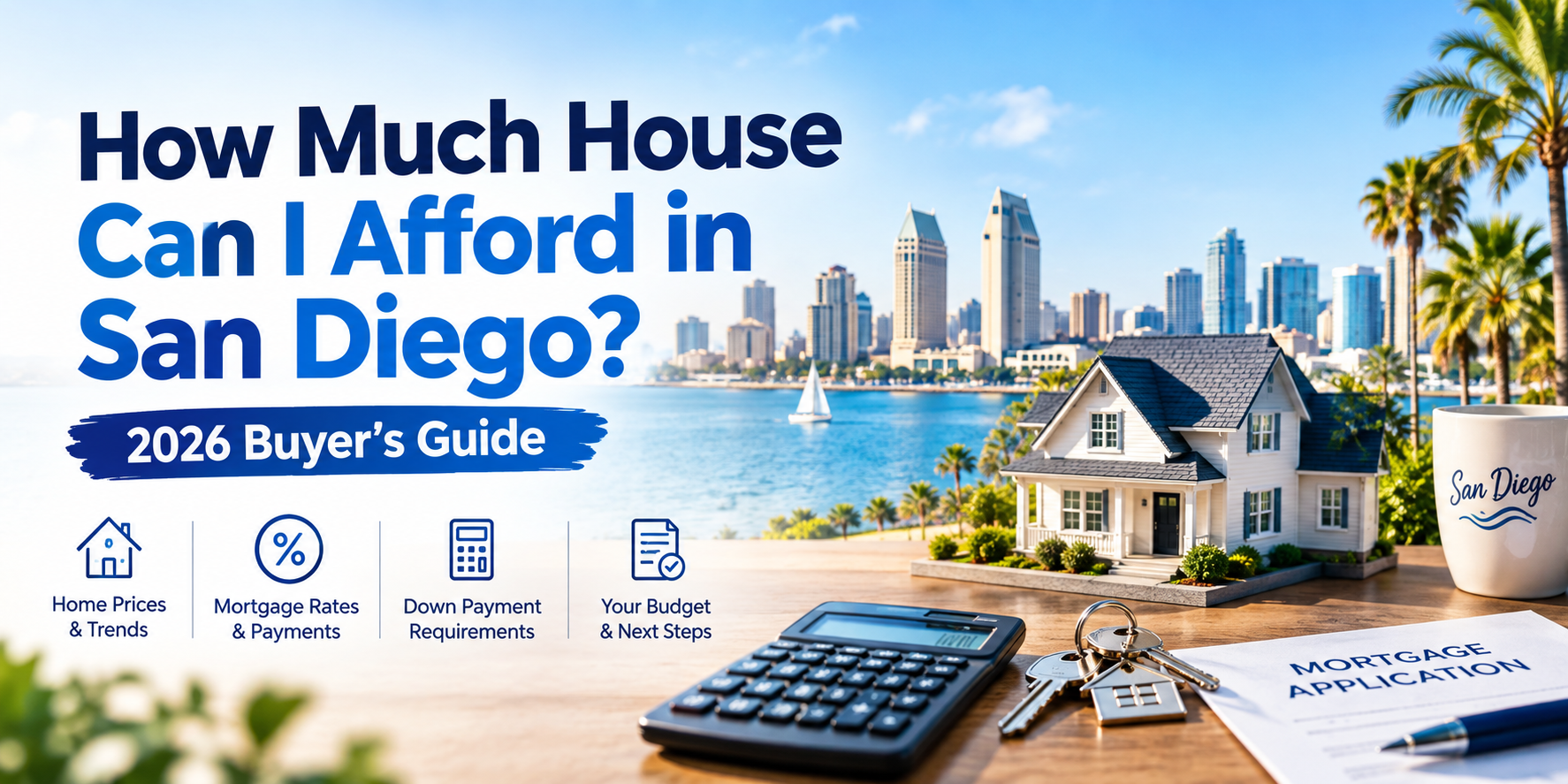
How Much House Can I Afford in San Diego? 2026 Guide
Quick Answer: How Much Income Do You Need to Buy in San Diego?
To buy a median-priced single-family home in San Diego County in 2026, many buyers may need a household income of approximately $240,000–$280,000+ per year, depending on their down payment, existing debts, credit profile, interest rate, property taxes, and other monthly expenses. For buyers with lower incomes, condos, townhomes, and homes in select North County communities may offer more attainable options.
📊 San Diego Affordability Baseline
- 🏡 Median Home Price: ~$900,000–$925,000 for single-family homes.
- 💵 Estimated Monthly Payment: ~$5,350 to $6,500 (including principal, interest, property taxes at ~0.75%, and insurance).
- 🎯 Required Salary: ~$240k+ for a traditional 28% housing ratio with a 20% down payment ($180,000).
💡 The 28/36 Rule
Mortgage lenders generally use your gross monthly income and existing debts to determine how much you can qualify for. The commonly used 28/36 framework suggests keeping housing costs around 28% of gross monthly income and total debt around 36%, although some qualified borrowers may be approved at higher debt-to-income ratios.
For example, a household earning $240,000 per year earns about $20,000 in gross monthly income. A 28% housing ratio would put the target housing budget at approximately $5,600 per month before considering how other debts affect qualification.
At Adam Kelley Real Estate, we help San Diego buyers look beyond the basic loan qualification number and understand what fits their actual budget. Your ideal purchase price can be very different depending on your down payment, monthly obligations, and the neighborhoods you’re considering.
This guide breaks down exactly what lenders look at, what different income levels can realistically buy in today’s market, and how to stretch your budget further without overextending yourself.
San Diego Housing Market Snapshot (2026)
Before you calculate your own number, it helps to know where the overall market stands:
- Median single-family home price: approximately $1,070,000–$1,150,000
- Median condo or townhome price: approximately $630,000–$660,000
- Average 30-year fixed mortgage rate: roughly 6.0%–6.8%
- Share of local households that can comfortably qualify for a median-priced home: about 17%–19%
If you’re weighing whether it makes more sense to buy now or wait, our breakdown of buying vs. renting in San Diego walks through the long-term math for both paths.
The 28/36 Rule: How Lenders Decide What You Can Afford
Mortgage lenders don’t just look at your income — they use a standard debt-to-income framework called the 28/36 rule to figure out your realistic borrowing power.
The Housing Ratio (28%)
Your monthly housing payment — principal, interest, property taxes, homeowners insurance, and any HOA dues — should generally stay under 28% of your gross monthly income. This is the number most lenders use as a starting point for preapproval.
The Total Debt Ratio (36%)
Your total monthly debt, including housing plus car payments, student loans, and credit cards, should ideally stay under 36% of gross income, though some loan programs allow this to stretch to 43%–45% for well-qualified borrowers. The lower your other debt, the more house you can typically afford.
What Different Budgets Buy in San Diego
Here’s how three common income levels translate into real buying power under current San Diego prices and rates:
| Annual Income | Monthly Housing Budget | What It Typically Buys |
|---|---|---|
| $120,000 | ~$2,800/mo | Condos or attached homes in the $450,000–$500,000 range with a solid down payment; detached single-family homes are largely out of reach. |
| $180,000 | ~$4,200/mo | Condos or townhomes around $630,000–$680,000, or an entry-level attached home in North County. |
| $240,000 | ~$5,600/mo | A single-family home in the $950,000–$1,000,000 range with 20% down — roughly the county median. |
Note: these figures assume a 20% down payment and no significant other monthly debt. Every household’s number will shift based on credit score, loan type, and how much cash is available upfront.
Beyond Income: Other Factors That Affect Affordability
Income is only part of the equation. These factors can move your real budget up or down significantly:
- Down payment size: a larger down payment lowers your monthly payment and can eliminate private mortgage insurance.
- Interest rate: even a half-point difference in rate can change your buying power by tens of thousands of dollars.
- Credit score: stronger credit typically unlocks better rates and loan terms.
- Existing debt: car payments, student loans, and credit card balances all count against your 36% ceiling.
- HOA fees: common in San Diego condos and planned communities, and they count toward your housing ratio.
Ways to Stretch Your Budget in San Diego
If your ideal home is currently out of reach, a few strategies can help close the gap:
Consider a Condo or Townhome First
Attached homes cost roughly 40% less than detached single-family homes in San Diego, making them a common entry point for first-time buyers. Before you buy, run through our home viewing checklist so you know exactly what to inspect.
Look at Rent-to-Own Arrangements
If you need time to improve your credit or save a larger down payment, rent-to-own homes in San Diego can be a way to lock in a purchase price while you get your finances in order.
Explore North County Suburbs
Coastal San Diego commands a premium, but inland and North County communities often stretch a budget further. Neighborhoods like Carlsbad, Oceanside, Escondido, and Bonsall all offer a mix of price points, from established single-family neighborhoods to newer master-planned communities.
Weigh a Cash or Low-Contingency Offer
If you have significant savings or investment funds, review the pros and cons of a cash offer — it can strengthen your position in a competitive listing without necessarily requiring a bigger income.
Steps to Take Before You Start House Hunting
- Get preapproved (not just prequalified) so you know your real budget
- Pull your credit report and address any errors or high balances
- Save for closing costs on top of your down payment — typically 2%–4% of the purchase price
- Work with an experienced local agent — see our top real estate agents in San Diego for a starting point
- Learn how to make a competitive offer before you’re in a bidding situation
- Understand the documents you’ll need after closing so nothing catches you off guard
Work With Someone Who Knows the Numbers
Affordability isn’t just about a lender’s spreadsheet — it’s about finding the right property in the right neighborhood for your budget. Choosing the right realtor who understands San Diego’s micro-markets can help you see options you’d otherwise miss, from up-and-coming pockets of North County to pros and cons of purchasing a property that’s a fixer versus move-in ready.
What It Takes to Buy, by Area
Rough monthly housing budget by North County community — coastal to inland. Figures assume 20% down at current rates.
|
Coastal
OceansideSurf-town pace, a working pier, and the county’s most accessible coastal condos. ~$4,200–$5,200/mo
|
Coastal
CarlsbadVillage charm, top-rated schools, and some of North County’s strongest resale value. ~$5,600–$7,000/mo
|
12 mi inland
EscondidoMore square footage and yard for the dollar, with easy freeway access back to the coast. ~$3,800–$4,800/mo
|
18 mi inland
BonsallRural acreage, horse property, and privacy for buyers who don’t need to be near the water. ~$4,500–$6,000/mo
|
Frequently Asked Questions
What income do I need to buy a house in San Diego in 2026?
Most households need $220,000–$240,000 in annual income to comfortably afford a median-priced single-family home. Buyers earning $120,000–$180,000 are generally better positioned for condos or townhomes.
What is the 28/36 rule?
It’s the debt-to-income framework most lenders use: your housing payment shouldn’t exceed 28% of gross monthly income, and your total debt (housing plus other obligations) shouldn’t exceed 36%, though some loans allow up to 43%–45%.
Can I still buy a home in San Diego on a moderate income?
Yes. Condos, townhomes, and North County suburbs remain within reach for households earning $120,000–$180,000, especially with a strong down payment or down payment assistance programs.
How much should I save for a down payment in San Diego?
A 20% down payment avoids private mortgage insurance and lowers your monthly payment, but many loan programs allow 3%–10% down. On a $1,000,000 home, 20% is $200,000; on a $650,000 condo, 20% is $130,000.
Should I get preapproved before house hunting?
Yes. Preapproval (not just prequalification) confirms your real budget with a lender and makes your offer more competitive in San Diego’s fast-moving market.
Ready to Find Your Number?
Every household’s true affordability number depends on income, debt, credit, and how much cash is available upfront. Adam Kelley works with San Diego buyers at every budget level — from first-time condo buyers in Oceanside to move-up buyers in Carlsbad — to find a home that fits comfortably within their real numbers, not just what a lender approves on paper. Reach out through adamkelleyrealestate.com to get a personalized affordability breakdown for your situation.

Adil Imran
Recent Posts

Realtor Choosing Mistakes: 10 Costly Errors to Avoid When Hiring a Real Estate Agent
How Much House Can I Afford in San Diego? 2026 Guide