
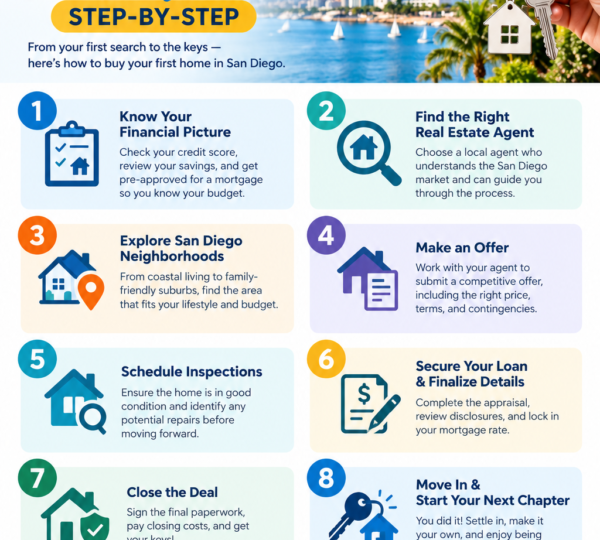
Quick answer: Buying your first home in San Diego in 2026 means budgeting for a median price near $925K–$1.05M, getting pre-approved before you shop, stacking down payment assistance like CalHFA MyHome or the SDHC deferred loan, and working with a local buyer’s agent who knows San Diego’s 70+ ZIP codes. Follow the nine steps below to go from “thinking about it” to holding your keys.
San Diego is one of the most competitive, and most rewarding, markets in the country to buy your first home. Between coastal price tags, military relocation timelines, and a patchwork of down payment programs, first-time buyers here need a plan, not just a Zillow app. This step-by-step guide walks you through exactly what to do, in order, so you can buy with confidence in 2026.
San Diego Housing Market Snapshot for 2026
Before you start touring open houses, it helps to understand what you’re walking into. As of mid-2026, the median home price in the City of San Diego sits in the $925,000–$950,000 range, while San Diego County (which includes more affordable inland and North County cities) runs closer to $900,000–$1.05 million depending on the data source and month. Mortgage rates have hovered between 6.0% and 6.8% for a 30-year fixed loan, with most forecasts calling for gradual, modest easing through the rest of the year.
Homes are still moving quickly in desirable pockets, often 20 to 30 days from list to pending, while some higher-priced listings are sitting longer as buyers grow more price-sensitive. That mix matters for a first-time buyer: it means well-priced starter homes in North County and East County can still attract multiple offers, even while the overall market cools slightly.
If you want a deeper dive into whether North County makes sense for your budget, our comparison of Carlsbad vs. Oceanside vs. Escondido breaks down price points and commute times for each city.
Step 1: Get Your Finances Ready
Check and strengthen your credit score
Most first-time buyer loan programs in San Diego require a minimum credit score somewhere between 580 (FHA) and 660–680 (many down payment assistance programs). Pull your credit report at least four to six months before you plan to shop. Pay down revolving balances, avoid opening new credit lines, and dispute any errors early, a 20-30 point bump can meaningfully change your interest rate.
Figure out what you can actually afford
Sale price is only part of the equation once you add property tax, homeowner’s insurance, and (for many San Diego condos and planned communities) HOA dues. A good rule of thumb is keeping your total housing payment under 30-36% of gross monthly income, though lenders will calculate your exact debt-to-income ratio during pre-approval. For a full walkthrough of the math, including how down payment size changes your monthly payment, see our guide on how much house you can afford in San Diego.
Build your down payment and closing cost fund
Closing costs in California typically run 2-5% of the purchase price on top of your down payment. Start a dedicated savings account now, and keep records of any large deposits, lenders will want to source and season any funds used for your down payment, including gifts from family.
Step 2: Explore First-Time Buyer Assistance Programs
San Diego first-time buyers have more help available in 2026 than most people realize. A few of the major programs:
- CalHFA MyHome Assistance Program, a deferred-payment second loan covering up to 3.5% of the purchase price for down payment or closing costs on FHA loans (3% on conventional), with 0% interest and no monthly payment until you sell, refinance, or transfer the home.
- CalHFA Dream For All, when funded, provides a shared-appreciation loan of up to 20% toward your down payment, repaid (plus a share of appreciation) when you sell or refinance.
- CalHFA Zero Interest Program (ZIP), pairs with MyHome to cover 2-3% of closing costs at zero interest.
- San Diego Housing Commission (SDHC) down payment assistance, a deferred loan of up to $10,000 (or 4% of the purchase price, whichever is less) for buyers earning up to 80% of area median income, plus a separate deferred loan program that can reach up to 22% of the purchase price for qualifying buyers.
- Mortgage Credit Certificates (MCC), a federal tax credit worth a percentage of the mortgage interest you pay each year, available through both CalHFA and SDHC (you cannot stack both versions).
Eligibility, income limits, and funding can change throughout the year. Confirm current requirements with CalHFA, SDHC, or your lender. Do this before building your budget around a specific program. A HUD-approved housing counselor can also help you combine multiple programs correctly.
Common Eligibility Requirements
Many assistance programs have similar requirements. You may need to complete an approved homebuyer education course. Some courses are available online for a small fee. You may also need to meet the program’s county income limits. In most cases, you must work with an approved lender.
Prepare Before You Find a Home
Funding for programs such as Dream For All can run out during the year. Prepare your documents early. Complete your homebuyer education course in advance. Keep your financial paperwork ready before making an offer. This can help you avoid delays when you find a home.
Ask About Combining Programs
Ask your lender if you can combine multiple assistance programs. For example, you may be able to pair a CalHFA MyHome second loan with an SDHC program. Some buyers may also qualify to use gift funds from family.
Not every combination is allowed. Program rules can also change. Discuss your options with your lender early. A HUD-approved housing counselor can provide additional guidance.
Step 3: Get Pre-Approved for a Mortgage
Pre-approval, not just pre-qualification, is what lets you make a credible offer in San Diego’s market. A pre-approval involves a lender verifying your income, assets, and credit, and it results in a letter stating how much you’re approved to borrow. Shop at least two to three lenders, since rates, fees, and down payment assistance partnerships vary. Ask each lender specifically which first-time buyer or down payment assistance programs they’re approved to originate, not every lender works with every program.
Step 4: Choose the Right San Diego Neighborhood
San Diego County covers more than 70 ZIP codes, and price, commute, and lifestyle can shift dramatically block to block. A few starting points for first-time buyers:
Coastal and central San Diego
Neighborhoods like North Park, Normal Heights, and University Heights attract buyers who want walkability and shorter commutes downtown, though prices run at or above the city median.
North County
Carlsbad, Oceanside, and Escondido offer a range of price points, from beach-adjacent Carlsbad to more attainable inland Escondido. If you’re relocating to the area, our full Escondido relocation guide covers schools, commute times, and neighborhood-by-neighborhood pricing.
South Bay and East County
Chula Vista, Lemon Grove, and parts of El Cajon tend to offer some of the county’s more attainable entry points for first-time buyers, with strong access to major job centers.
Before falling in love with a specific ZIP code, tour a few neighborhoods on foot or by car at different times of day, traffic, noise, and walkability all read very differently at 8 a.m. versus 8 p.m.
It’s also worth thinking beyond your first purchase. San Diego’s job market is anchored by defense, biotech, and healthcare employers, which tends to support home values even when the broader market softens. If you expect to be in the home for only three to five years, prioritize neighborhoods with strong historical resale demand over ones that are simply the cheapest option today. Your agent can pull historical appreciation data for specific streets and school zones, not just citywide averages, which is often more useful for a first-time buyer trying to balance affordability against long-term equity growth.
Step 5: Find a San Diego Real Estate Agent You Trust
A skilled buyer’s agent is free to you as the buyer in most transactions (their commission is typically paid through the sale), and in a market as nuanced as San Diego’s, that local expertise is invaluable, from knowing which HOAs are financially healthy to which streets flood in heavy rain. Look for an agent who works your target neighborhoods regularly, communicates clearly, and is willing to walk first-time buyers through every step rather than rushing to an offer.
Not sure what to look for in an agent? Our guide on how to choose a realtor in San Diego covers the exact questions to ask before you sign a buyer’s agreement.
Step 6: House Hunting — What to Look For
Once you’re pre-approved and paired with an agent, the search begins. Beyond the obvious (bedrooms, bathrooms, square footage), first-time buyers should pay close attention to:
- Roof, foundation, and major systems age, replacing an HVAC system or roof can run into five figures.
- HOA health, ask for the HOA’s reserve study and recent meeting minutes; a poorly funded HOA can mean sudden special assessments.
- Flood, fire, and wildfire risk, San Diego County has areas with real exposure to both flooding and wildfire; check disclosures carefully.
- Resale factors, school boundaries, lot orientation, and proximity to noise sources (freeways, airports, trolley lines) all affect future resale value.
We built a full home viewing checklist you can bring (digitally or printed) to every showing so nothing gets missed in the moment.
It’s easy for first-time buyers to get swept up in staging and finishes during a showing. Try to mentally separate cosmetic issues (paint, dated fixtures, landscaping), which are cheap and easy to change later, from structural or systems issues, which are expensive and much harder to fix. A home with great bones and outdated cabinets is often a better long-term buy than a beautifully staged home with a 20-year-old roof.
Step 7: Make a Competitive Offer
In San Diego’s competitive listings, price is only one lever. Your agent can help you structure an offer using some combination of:
- A strong, verified pre-approval letter (or proof of funds for cash offers)
- A reasonable, well-researched offer price backed by comparable sales
- Flexible close and possession timelines that match the seller’s needs
- Limiting contingencies thoughtfully, without waiving protections you genuinely need as a first-time buyer, like inspection and loan contingencies
Renting before you buy and wondering whether it’s the smarter move for your situation? Our breakdown of buying versus renting in San Diego walks through the long-term math.
Step 8: Home Inspection and Appraisal
Once your offer is accepted, two separate processes protect you and your lender:
The home inspection
A licensed inspector checks the property’s physical condition, roof, plumbing, electrical, foundation, and more, typically within the first week or two of your contract. Attend if you can; it’s the best education you’ll get on how your future home actually works.
The appraisal
Your lender orders an independent appraisal to confirm the home is worth what you’ve agreed to pay, since the loan is secured by the property itself. If the appraisal comes in below your offer price, you’ll need to renegotiate, bring additional cash to closing, or in some cases walk away. Curious what an appraiser is actually looking at (and why it doesn’t always match your inspection)? Read our explainer on what an appraiser does in real estate.
Step 9: Closing on Your Home
Closing in California typically happens through escrow rather than a single in-person signing table. You’ll review and sign loan documents (often at a title company or via mobile notary), wire your remaining closing funds, and the sale records with the county once everything clears. Keep every document you receive, insurance policies, the settlement statement, recorded deed, and loan documents, in one place. Our guide to the essential real estate documents to keep after closing lays out exactly what to file and for how long.
Common First-Time Buyer Mistakes to Avoid in San Diego
- Shopping before getting pre-approved, which wastes time on homes outside your real budget.
- Underestimating total monthly costs, especially HOA dues and California’s relatively high homeowner’s insurance.
- Skipping the home inspection to make an offer more competitive, a shortcut that can cost far more later.
- Not researching down payment assistance early, since some programs require homebuyer education courses completed before you can use the funds.
- Choosing an agent based on a listing sign instead of a track record with buyers, first-time buyers specifically, and your target neighborhoods.
- Waiving the appraisal or inspection contingency to win a bidding war without fully understanding the financial exposure if the home appraises low or hides a costly defect.
- Forgetting to rate-shop your homeowner’s insurance, since California insurance costs, especially near wildfire-risk zones, can vary significantly between carriers for the same property.
- Draining savings entirely for the down payment, leaving no cushion for moving costs, immediate repairs, or the first few months of homeownership.
Frequently Asked Questions
How much do I need to save to buy my first home in San Diego?
It depends heavily on the program you use. An FHA loan requires as little as 3.5% down, and down payment assistance through CalHFA MyHome or SDHC can reduce your out-of-pocket cash further. On a $900,000 home, 3.5% down is roughly $31,500, plus 2-5% in closing costs, though assistance programs can lower that meaningfully.
Do I qualify as a “first-time” buyer if I owned a home years ago?
Most California and San Diego assistance programs define a first-time buyer as someone who hasn’t owned a primary residence in the past three years, so many past owners still qualify.
Is it better to buy in the City of San Diego or North County as a first-time buyer?
It depends on your budget and commute needs. North County cities like Escondido and parts of Oceanside generally offer more attainable entry points than coastal and central San Diego neighborhoods, while still keeping commute times reasonable for many jobs.
How long does it take to close on a home in San Diego once an offer is accepted?
A traditional financed purchase typically takes 30-45 days from accepted offer to closing, depending on your lender, loan type, and how quickly inspection and appraisal contingencies are resolved.
Should I use a real estate agent as a first-time buyer, or can I go directly to a listing agent?
Using your own buyer’s agent, one who represents only your interests, is almost always the safer choice for a first-time buyer, and in most transactions their commission doesn’t come out of your pocket directly.
Ready to Start Your San Diego Home Search?
Buying your first home is one of the biggest financial decisions you’ll make, and San Diego’s market rewards buyers who prepare early and move with a plan. Adam Kelley works with first-time buyers throughout San Diego County, from pre-approval conversations through closing day, helping you navigate down payment assistance programs, competitive offers, and every step in between. If you’re ready to talk through your options or just want a second opinion on a listing you found, reach out to start the conversation.