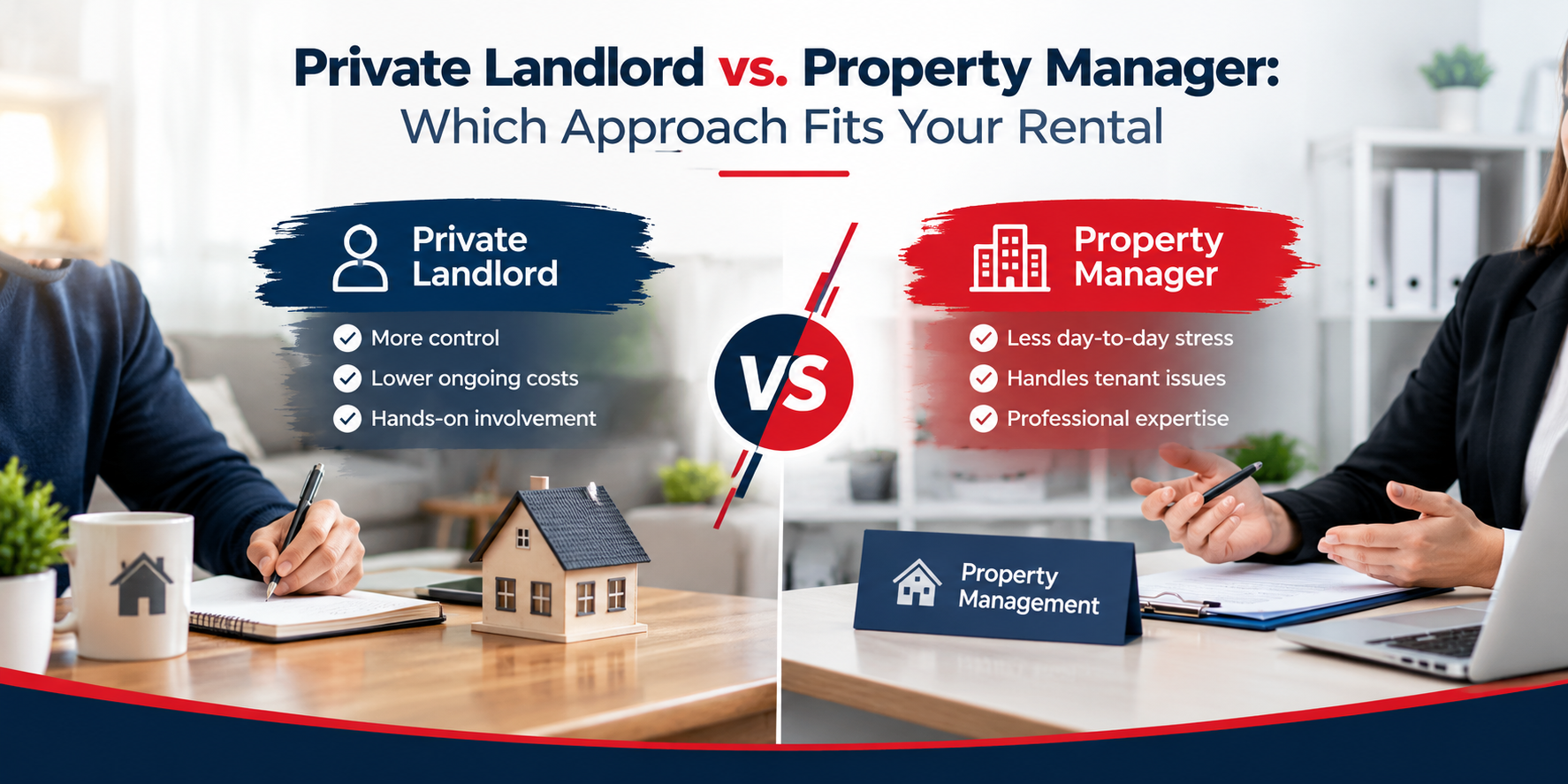
Private Landlord vs Property Manager: The Quick Comparison
A private landlord manages their own rental and keeps 100% of the rent, while a property manager runs day-to-day operations for a fee, typically 6% to 12% of monthly rent. The right choice depends on how many hours you can give, how close you live to the property, and how comfortable you are with California landlord-tenant law. Self-management usually fits nearby, hands-on owners with one or two units. Professional management usually fits out-of-town owners, busy professionals, and larger portfolios.
If you own a rental in San Diego County, this decision is more than a spreadsheet exercise. Rents are high, tenant protections are strict, and one mishandled deposit or notice can cost more than a year of management fees. This guide compares self-management with professional management across time, tenant communication, maintenance, marketing, screening, and fees, so you can choose the approach that protects both your income and your peace of mind. If you are still deciding whether to hold a property at all, our breakdown of the pros and cons of purchasing a property is a useful companion read.
Here is the short version before we go deeper. Use the table to see where each approach wins.
| Factor | Private Landlord | Property Manager |
|---|---|---|
| Cost | No management fee, but you pay in time and DIY costs | Commonly 6%–12% of monthly rent plus leasing fees |
| Time | Often 40+ hours a year, more during turnover | A few hours a year reviewing statements |
| Tenant communication | Direct and personal | Handled by staff, portals, and after-hours lines |
| Maintenance | You coordinate every repair | Vendor network and 24/7 dispatch |
| Marketing | You write, photograph, and post the listing | Professional listings and syndication |
| Screening | Your judgment and your process | Standardized criteria applied consistently |
| Legal risk | Fully yours | Shared with a licensed professional |
| Control | Total | Delegated, with owner approval limits |
| Best for | Nearby, hands-on owners with 1–2 units | Out-of-town owners, busy professionals, multi-unit portfolios |
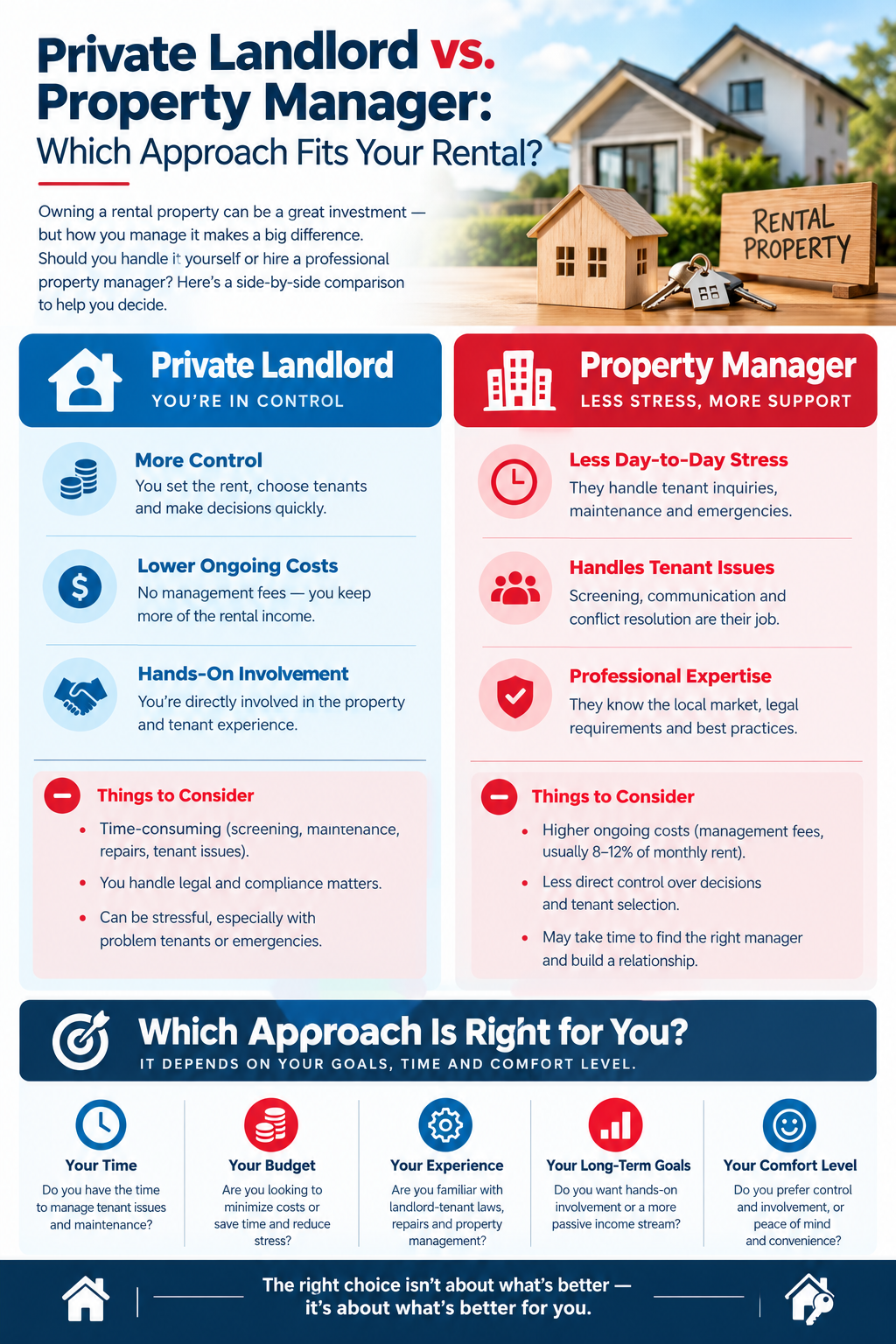
Notice the pattern: self-management trades your time for savings, and professional management trades fees for time and risk reduction. Neither is automatically better. Renters feel the difference too, which is why many tenants searching for private landlords in San Diego are really looking for a more personal, flexible relationship than a large company usually offers.
What Is a Private Landlord?
A private landlord is an individual owner who rents out property and personally handles the work of being a landlord. That means advertising the unit, screening applicants, signing the lease, collecting rent, answering tenant calls, arranging repairs, and handling move-out. Some private landlords own a single condo they kept after moving. Others own several small buildings and self-manage them for decades.
The appeal is straightforward. You choose your tenants, set your own lease terms within the law, and keep every dollar of rent after expenses. You also build a direct relationship with the people living in your property, which often leads to longer tenancies and more careful care of the home. Tenants exploring options like rent-to-own homes in San Diego frequently seek exactly this kind of flexible, owner-direct arrangement.
The tradeoff is that you are the company. Every late-night leak, every missed payment, and every legal notice lands on your desk. If you enjoy hands-on work and live close to the rental, that can be rewarding. If you dread it, the savings can disappear quickly.
What Does a Property Manager Do?
A property manager is a professional, or a company, hired by the owner to run a rental for a fee. Managers act as the middleman between owner and tenant, so the owner does not have to. When people ask what a property manager does, the honest answer is nearly everything except owning the building. Typical duties include:
- Marketing vacancies, photographing units, and conducting showings
- Screening applicants for income, credit, rental history, and identity
- Preparing leases, move-in inspections, and required disclosures
- Collecting rent, issuing late notices, and providing owner statements
- Coordinating maintenance, vendors, and emergency repairs
- Serving legal notices and following the required process for lease violations
- Handling move-out inspections and security deposit accounting
In California, a company that collects rent or manages property for others in exchange for compensation generally needs to operate under a real estate broker license. Before hiring anyone, verify the license through the California Department of Real Estate. The same due diligence you would apply when you choose a realtor applies here: check credentials, ask for references, and read the agreement carefully.
Time Commitment: How Many Hours Does Self-Management Take?
Commonly cited estimates put self-management at roughly 40 hours a year for a single, stable rental. That figure is a baseline, not a promise. It assumes a long-term tenant, no major repairs, and no legal disputes. In real life, hours cluster around three moments: finding a tenant, handling a big repair, and dealing with a problem tenant.
A vacancy alone can consume 15 to 25 hours between writing the listing, answering inquiries, showing the unit, screening applicants, and completing the lease. Add a water heater failure or an HVAC outage and you may spend a weekend coordinating quotes and access. A property manager compresses nearly all of that into a monthly statement.
Ask yourself what your time is worth. If you earn a high hourly rate at your job or simply value your weekends, paying 8% to 10% of rent may be cheaper than it looks. If you have flexible time and live nearby, self-managing can be a smart way to boost returns. Owners weighing the long-term math often start with our comparison of buying a home versus renting to understand the broader tradeoffs of owning property.
Tenant Communication: Personal Touch vs Professional Buffer
As a private landlord, you are the single point of contact. Tenants text you directly, and you decide how to respond. That closeness can build trust, and it lets you resolve small issues informally. It also means you are reachable at inconvenient hours, and blurred boundaries can make it harder to enforce rules or address late rent.
A property manager creates a professional buffer. Requests go through an online portal or a call center, every message is documented, and decisions follow a written policy. Documentation matters more than most owners realize. If a dispute ever reaches small claims court or a housing agency, a clean paper trail of notices, requests, and responses is your best evidence.
The downside of management is impersonality. Some tenants feel like a ticket number, and a poor manager can damage your relationship with good residents. When you interview companies, ask about response-time standards, who tenants actually speak with, and how renewals are handled. If you already have a great tenant, ask whether the manager will honor that relationship.
Maintenance and Repairs: Who Handles the 2 A.M. Call?
Maintenance is where self-management is won or lost. Owners with construction skills and a reliable handyman can keep costs low and respond quickly. Owners without those resources often overpay for emergency service or let small issues grow into expensive ones.
Property managers typically maintain a network of licensed, insured vendors who offer negotiated rates and fast response. Many provide 24/7 dispatch, so a burst pipe at midnight becomes their problem first and your approval second. Most agreements set a repair threshold, such as approval required above a set dollar amount, so you stay in control of larger spending.
Watch for hidden costs. Some companies add a markup to vendor invoices or charge a project management fee on larger repairs. Ask for the policy in writing. Preventive maintenance, such as annual HVAC service, gutter cleaning, and smoke detector checks, is worth doing either way. It reduces emergencies and supports your property value, which also matters when it is time to sell. For a sense of how condition affects value, see what an appraiser does in real estate.
Marketing Your Rental: DIY Listings vs Professional Exposure
Filling a vacancy quickly is the most direct way to protect your income, because every empty month is money you never recover. Self-managing owners usually post to a handful of rental sites, take their own photos, and respond to inquiries as they arrive. With good photos, honest descriptions, and correct pricing, this works well in a hot market.
Professional managers bring pricing data, staged photography, syndication to major rental platforms, and a system for scheduling showings. They also know how to price against current comparables, which matters because overpricing extends vacancy while underpricing leaves money on the table. That expertise is one of the strongest reasons owners hire out, especially in a competitive coastal market.
Local knowledge plays a role too. Rent expectations differ between coastal neighborhoods and inland communities, and tenant demand shifts by season. If you are unsure how a specific area performs, our comparison of Carlsbad, Oceanside, and Escondido offers a helpful look at how North County neighborhoods differ in character and cost.
Tenant Screening: Judgment vs Process
Screening is the single most important decision in renting. A good tenant pays on time, cares for the home, and stays. A bad one can cost you months of lost rent, legal fees, and repairs. Careful screening usually includes verifying identity, confirming income, checking credit, contacting prior landlords, and reviewing rental history.
Private landlords have flexibility. You can weigh the whole picture, such as a thin credit file offset by a strong rental history. That discretion is useful, but it also creates risk. Inconsistent standards can lead to fair housing complaints, so use the same written criteria for every applicant and apply them evenly.
Property managers apply a standardized process, run reports through established screening services, and are trained in fair housing rules. That consistency protects you legally. If you self-screen, keep records, follow California limits on application fees, and never base decisions on protected characteristics. Owners who are also renters themselves may appreciate the perspective in our article on finding and vetting private landlords, which explains what applicants expect from a legitimate owner.
Legal Compliance in California: The Hidden Cost of DIY
California has some of the most detailed landlord-tenant rules in the country, and the City of San Diego adds its own just-cause protections. Rules commonly affecting small owners include statewide rent caps under AB 1482 for covered units, security deposit limits under AB 12 (generally one month’s rent, with an exception for certain small landlords), required written notice before entering a unit, and a strict timeline for returning deposits after move-out. Which rules apply to your property depends on its age, ownership structure, and location.
Mistakes are expensive. A defective notice can restart an eviction from day one. An improperly handled deposit can lead to penalties. Because these laws change, a professional who works with them every day has a real advantage. Fair housing compliance is equally important, since discrimination claims can arise from something as simple as an unequal answer to an inquiry.
This is general information, not legal advice. Whether you self-manage or hire a manager, consult a qualified California landlord-tenant attorney for specific situations. Also keep organized records of leases, notices, and receipts, similar to the paperwork discipline described in our list of essential real estate documents.
How Much Do Property Managers Charge?
Property management fees vary by company, property type, and market, but the most commonly cited range is 6% to 12% of monthly rent for ongoing management. Many companies land around 8% to 10% for single-family homes and condos, while multi-unit portfolios may negotiate lower percentages. Fees are almost never limited to the monthly percentage, so read the full fee schedule.
- Monthly management fee: a percentage of collected rent, sometimes with a minimum
- Leasing or tenant placement fee: often a portion of, or up to, one month’s rent
- Lease renewal fee: a flat fee when a tenant renews
- Setup or onboarding fee: charged when you sign the management agreement
- Maintenance markup or coordination fee: added to repair invoices
- Eviction handling and inspection fees: charged when those services are needed
- Early termination fee: charged if you cancel before the contract ends
This is how to think about how much a property manager costs on a typical rental. The numbers below are simple illustrations using a $3,000 monthly rent, not quotes from any company.
Add a leasing fee and occasional renewal or inspection charges, and your first-year total will be higher. Ask each company for an all-in cost estimate, and compare more than the headline percentage. A company with an 8% fee and heavy add-ons can cost more than one with a 10% flat fee. If you are also evaluating whether a rental fits your investment goals, our property listings can help you gauge local rents and values.
The True Cost of Self-Management
Self-managing is not free, even though you pay no management fee. Your costs show up elsewhere: advertising, screening reports, legal forms, landlord insurance, repair overruns, and above all your time. If you spend 40 hours a year at an opportunity cost of $50 an hour, that is $2,000 of unpaid labor, before counting any vacancy that lasts longer because of slow marketing.
The bigger risk is the mistake you do not see coming. One improper notice, one missed disclosure, or one poor screening decision can outweigh several years of savings. That does not mean self-management is a bad idea. It means the savings are real only if you have the time, the knowledge, and a system. If you enjoy the work, you will likely come out ahead. If you do not, you may not.
Pros and Cons: Private Landlord vs Property Manager
Here is a balanced look at each option.
Private Landlord: Advantages
- Keep 100% of rent with no management fee
- Full control over tenant selection, lease terms, and repairs
- Direct relationships that can increase tenant retention
- Complete visibility into your property’s condition and finances
Private Landlord: Disadvantages
- Significant time commitment, especially during vacancies
- Full legal liability for compliance mistakes
- Emergency calls and difficult conversations fall on you
- Harder to manage from a distance
Property Manager: Advantages
- Saves time and provides mostly passive income
- Professional screening, marketing, and legal compliance
- Vendor network and 24/7 maintenance response
- Works well for out-of-town owners and larger portfolios
Property Manager: Disadvantages
- Fees reduce your net return, and add-on charges can surprise you
- Less day-to-day oversight and less personal tenant contact
- Quality varies widely between companies
- Contracts may include termination fees or long commitments
Which Approach Fits Your Rental? A Simple Decision Guide
Use these questions to decide. The more “yes” answers you give in one column, the clearer your path.
Self-management likely fits if: you live within a reasonable drive of the property, you own one or two units, you have flexible time, you enjoy hands-on work, and you are willing to learn California landlord-tenant law. It also fits owners who already have a trusted handyman and a stable, long-term tenant.
Professional management likely fits if: you live out of the area, you work long hours, you own several units, you have had a difficult tenant experience, or you simply want passive income. It is also a smart choice for owners in high-regulation situations, such as covered units under rent-cap rules.
A Middle Path: Hybrid and Leasing-Only Management
You do not have to choose all or nothing. Some companies offer tenant-placement-only services, where they market the unit, screen applicants, and prepare the lease, then hand the property back to you. This is a good fit for self-managing owners who want professional help with the riskiest stage, finding the right tenant.
Others offer partial or a la carte services, such as rent collection only, or maintenance coordination only. Another option is to self-manage for a period, learn the ropes, and hire a manager later as your portfolio grows or your life gets busier. Just make sure any transition is smooth, with organized lease files, tenant contact information, and a clear handoff date. Keeping your documents tidy, as covered in our guide to post-closing paperwork, makes that transition far easier.
How to Choose a San Diego Property Manager
If you decide to hire, treat the search like a job interview. San Diego property management companies range from boutique firms to large operations, and the right fit depends on your property type and expectations. Compare at least three companies, and ask about:
- Licensing: confirm an active California broker license
- Fees: request a written, all-in fee schedule including add-ons
- Experience: ask how many properties like yours they manage in your area
- Communication: ask how quickly they respond and who your contact will be
- Maintenance: ask about vendor approval limits and any markups
- Reporting: ask for a sample owner statement and how often you receive one
- Contract terms: ask about length, termination rights, and fees to exit
- References: speak with current owners, not just testimonials
Read the management agreement line by line before signing. Pay special attention to who holds the security deposit, how trust accounts are handled, and what happens to your tenant records if you leave. A trustworthy manager will welcome these questions. Real estate professionals who understand both sales and rentals can also point you toward reliable managers, which is one reason owners often start with a conversation with a local agent, as we describe when explaining how to choose a realtor.
How to Become a Property Manager
Some readers of this topic are not owners at all. They are people curious about becoming a property manager themselves. In California, managing property for others for compensation generally requires working under a licensed real estate broker, or holding a broker license yourself. The usual path includes real estate education, a salesperson license, experience, and additional coursework and testing for a broker license if you want to run your own company.
Beyond the license, successful managers develop skills in fair housing law, accounting, maintenance coordination, and customer service. Many start in an assistant or leasing role at an established firm. Requirements change, so check the California Department of Real Estate for current rules. Anyone exploring a real estate career can also learn from the profiles in our guide to the top real estate agents in San Diego.
Final Thoughts: Which Approach Fits Your Rental?
The private landlord vs property manager question comes down to a trade. Self-management gives you control and saves fees, but it costs time, requires legal knowledge, and puts all the risk on you. Professional management costs a percentage of rent, but it delivers convenience, consistency, and protection. The best choice is the one that matches your schedule, your location, and your tolerance for hassle.
If you are still unsure, start by counting your units, noting how far you live from the property, and deciding whether you want a passive or hands-on experience. Then get quotes from two or three managers and compare them against your own realistic time cost. For help evaluating a rental, buying an investment property, or preparing a property for the market, contact Adam Kelley through AdamKelleyRealEstate.com and get local guidance for San Diego, Carlsbad, Oceanside, Escondido, and nearby communities.
Frequently Asked Questions
What is the difference between a private landlord and a property manager?
A private landlord is an owner who personally manages their rental, including marketing, screening, rent collection, and repairs. A property manager is a professional or company that performs those tasks for the owner in exchange for a fee. The landlord owns the property either way. The difference is who does the daily work and who carries the operational and legal burden.
How much do property managers charge?
Property managers commonly charge 6% to 12% of monthly rent for ongoing management. Many also charge a leasing fee when they place a tenant, often a portion of or up to one month’s rent, plus possible renewal, setup, or inspection fees. Always request a full written fee schedule.
How much does a property manager cost for one rental?
On a $3,000 monthly rent, an 8% fee is about $240 a month, or $2,880 a year, before leasing or add-on fees. Costs scale with rent, so compare the all-in annual cost rather than only the percentage.
What does a property manager do?
A property manager markets vacancies, screens tenants, prepares leases, collects rent, coordinates maintenance, handles tenant communication, serves required notices, and provides owner statements. Many also manage move-in and move-out inspections and deposit accounting.
Can I manage my rental property myself in California?
Yes. Owners can legally self-manage their own rentals. However, California and local laws on deposits, notices, rent caps, and fair housing are detailed, so you should learn the rules that apply to your property and consider consulting a landlord-tenant attorney for complex situations.
Is it worth hiring a property manager for a single rental?
It can be, especially if you live far away, work long hours, or want passive income. If you live nearby, have free time, and enjoy hands-on work, self-management may be worth it. Compare the fee to the real value of your time and risk.
How do I become a property manager in California?
Managing property for others for compensation generally requires working under a licensed real estate broker or holding a broker license. Most people begin with real estate education and a salesperson license, gain experience, and then pursue broker requirements if they want their own firm. Confirm current rules with the California Department of Real Estate.
Can I switch from self-managing to a property manager later?
Yes. Many owners self-manage at first and hire a manager as their portfolio grows or their schedule changes. Organize your leases, tenant contacts, and maintenance records in advance so the handoff is smooth.