The fastest way to find investment properties in San Diego is to run three channels at once: an agent-built MLS search filtered to your numbers, a watchlist for multifamily and commercial listings on platforms like LoopNet, and an off-market pipeline of owners, wholesalers, and local lenders. Then test every property against cap rate, cash flow, and accessory dwelling unit (ADU) potential before you make an offer. Investors who win in this market rarely find one “perfect listing.” They build a repeatable sourcing system and let good deals come to them. If you are still deciding whether investing beats owning your own home first, read why you should buy a home vs. rent before you go further.
San Diego is one of the most expensive and most supply-constrained rental markets in the country. Recent Redfin-reported investor listings have hovered near a $899,000 median for residential properties, and multifamily cap rates on LoopNet have generally run from roughly 2.9% to 6.1%. Those figures move monthly, so treat them as a starting benchmark and confirm current numbers before you commit. This guide covers where to look, which neighborhoods fit which strategy, how to run the numbers, and how to avoid the mistakes that cost new investors the most. If you want a local partner while you read, the team at Adam Kelley Real Estate works with San Diego and North County buyers every week.
Quick Answer: Where to Find Investment Properties in San Diego
- MLS and agent searches: the most complete and up-to-date source of on-market single-family homes, condos, and small multifamily.
- Online aggregators: Redfin, Zillow, and similar sites are useful for tracking prices and days on market.
- LoopNet and commercial brokers: the main source of apartment buildings and mixed-use properties.
- Off-market scouting: drive neighborhoods, write to owners, and watch for tired landlords and distressed homes.
- Wholesalers, bankers, and agents: pocket listings and pre-foreclosure leads come through relationships.
- Auctions and bank-owned homes: higher risk, sometimes higher reward.
What Counts as an Investment Property in San Diego?
An investment property is any real estate you buy primarily to earn income or appreciation rather than to live in. That includes single-family rentals, condos, duplexes through fourplexes, larger apartment buildings, homes with ADUs, and short-term vacation rentals. Lenders treat these differently from a primary residence, which changes your down payment, interest rate, and paperwork.
The category matters because it shapes where you search. A first-time investor with $200,000 to deploy will usually look at condos, townhomes, and small multifamily on the MLS. A more experienced buyer may target five-plus units on LoopNet. If you are new to the mechanics of purchasing, the pros and cons of purchasing a property is a helpful primer on what you are signing up for.
Before you search, write down your goal in one sentence. “I want positive cash flow in year one” leads to a very different search than “I want long-term equity growth and can carry a small monthly loss.” Every channel below works better once your goal is clear.
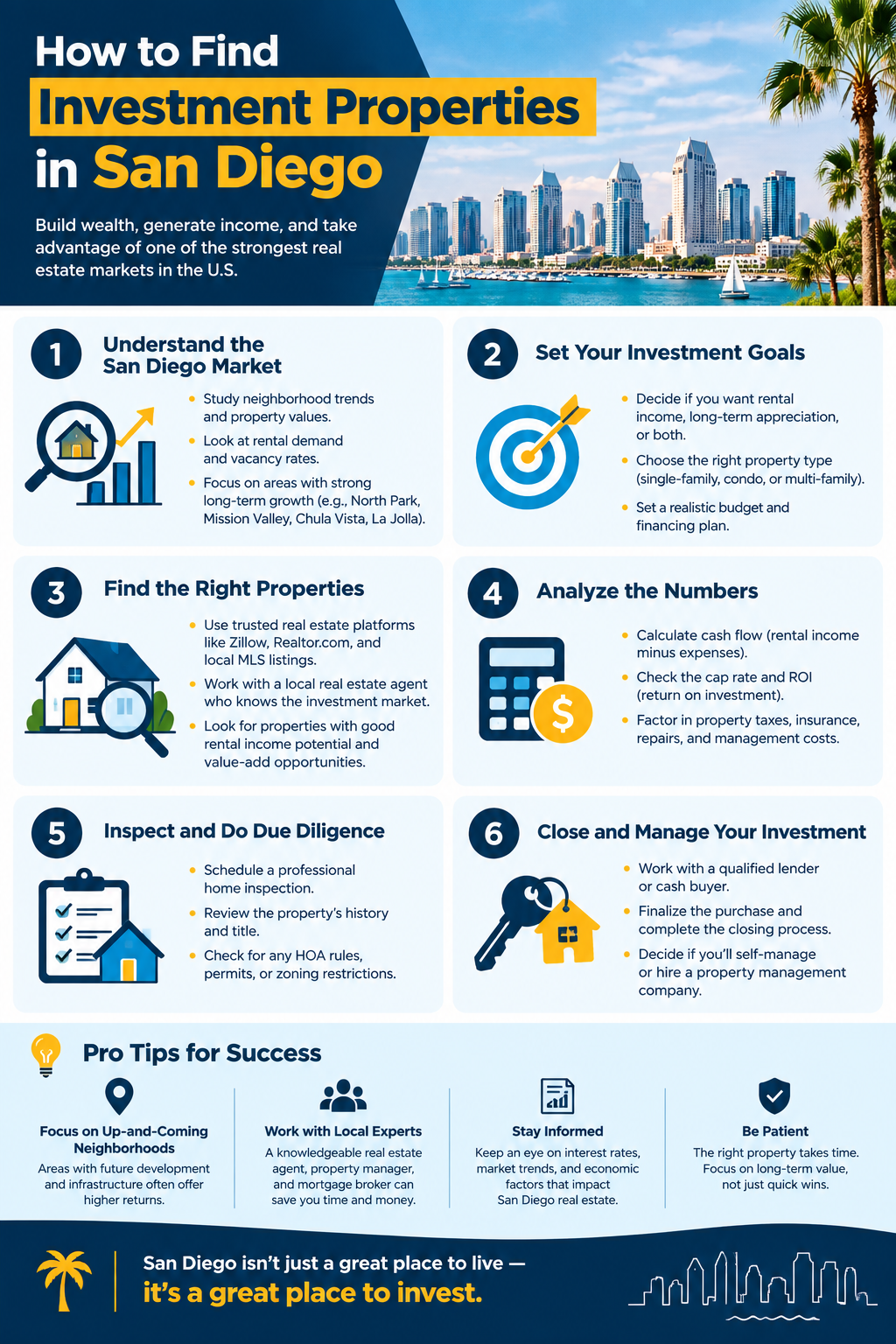
Where to Find Investment Properties in San Diego: 7 Proven Channels
1. The MLS Through a Local Investor-Friendly Agent
The Multiple Listing Service is where most on-market properties first appear, often hours or days before they reach consumer websites. A local agent can set up automatic alerts filtered by price, unit count, lot size, rent potential, and ADU-ready lots, so you see new listings the moment they hit.
The bigger advantage is judgment. An experienced agent knows which listings are overpriced for their rents, which streets have chronic problems, and which sellers are motivated. That is why choosing the right professional matters. Use the guide on how to choose a realtor in San Diego and ask any agent you interview how many investor clients they have worked with in the past year.
2. Online Aggregators Like Redfin and Zillow
Consumer search sites are the easiest place to start. Redfin’s San Diego investment home pages, saved-search alerts, and price history make it simple to watch inventory and track median prices. Use them to learn the market: note which neighborhoods list at what price per square foot, how quickly homes go pending, and how often prices are cut.
Aggregators have limits. Listing data can lag the MLS, rent estimates are often generic, and the best deals may be gone before an alert reaches you. Treat these sites as your research desk, not your only source. Pair them with a broker-curated property search so nothing slips through.
3. LoopNet and Commercial Listing Platforms
If you want apartment buildings, mixed-use, or small commercial properties, LoopNet is the standard starting point. Filter by property type (multifamily), unit count, price range, and cap rate. Listings often show gross income and expenses, which lets you pre-screen deals in minutes.
Be careful with advertised cap rates. Sellers sometimes present “pro forma” numbers based on rents they hope to charge rather than what tenants actually pay. Always request the rent roll, trailing twelve-month operating statement, and utility bills. Many multifamily deals also come from commercial brokers who never post publicly, so introduce yourself to two or three of them.
4. Off-Market Scouting
Off-market properties are homes the owner has not listed, and they can offer less competition and better terms. Practical tactics include:
- Driving target neighborhoods for “For Sale By Owner” signs, overgrown yards, boarded windows, and dated exteriors.
- Watching for old rental ads that keep reappearing, which can signal tired landlords.
- Mailing handwritten letters to owners of duplexes, triplexes, and out-of-state landlords.
- Checking county records for long-term owners, absentee owners, and properties with tax delinquencies.
Off-market work takes persistence. Expect many conversations for each real opportunity. If you already talk with small landlords, the article on how to find private landlords shows how private owners advertise, which is useful when you want to approach them as a buyer instead of a tenant.
5. Wholesalers, Bankers, and Pocket Listings
Wholesalers put distressed homes under contract and then assign the contract to an end buyer for a fee. Local bankers and credit union lenders see pre-foreclosures and troubled loans before the public does. Agents often hold pocket listings, meaning properties they market quietly to a select group of buyers.
To access these, build relationships instead of asking for favors. Attend local real estate investor meetups, tell people exactly what you buy, and prove you can close. When a deal appears, the person who answers fast with proof of funds gets the first call. An agent with a strong local reputation is often the shortest path, and the top 10 real estate agents in San Diego is a good place to start comparing.
6. Foreclosures, Auctions, and Bank-Owned Homes
Trustee auctions and real estate owned (REO) properties can sell below market value, but they carry real risk. Auction properties usually require cash or cashier’s checks, offer limited inspection access, and may come with liens or occupants. REO homes are easier to buy through an agent, though competition is strong and many are in poor condition.
These deals suit experienced buyers with repair budgets and title research support. If you are weighing an all-cash strategy, the pros and cons of cash home buying explains how speed and certainty can win in competitive situations.
7. Seller Financing and Creative Structures
Some San Diego owners, especially those with substantial equity, will consider seller financing, lease options, or rent-to-own arrangements. These structures can let you buy with less bank involvement and more flexible terms. They also carry legal complexity, so always involve a real estate attorney. To understand one common version, read how rent-to-own homes in San Diego work.
Best San Diego Neighborhoods for Investment Properties
The right neighborhood depends on your strategy. Here are the areas investors most often evaluate, with the tradeoffs of each.
North Park
North Park is popular with young professionals thanks to walkability, restaurants, and central location. That steady demand makes it a strong choice for long-term rentals, and tenant turnover tends to be manageable. Purchase prices are high, and older housing stock can carry maintenance surprises, so inspect carefully and budget for repairs.
Logan Heights
Logan Heights attracts value-add investors who want to renovate and add ADUs. Prices generally sit below many central neighborhoods, and lots can offer room for additional units. Your returns depend heavily on renovation costs and permitting, so get contractor bids and confirm zoning before you buy.
La Jolla and Coastal Pockets
Coastal areas such as La Jolla have high barriers to entry and premium prices. Investors buy here for lifestyle demand, tenant quality, and long-term equity growth rather than immediate cash flow. Expect low cap rates. This is a wealth-preservation play, not an income play.
Rancho Bernardo
Rancho Bernardo is a suburban, master-planned community with lower entry points than the coast, strong schools, low crime, and steady demand from family renters. It often works well for buy-and-hold investors who want stability, longer tenancies, and simpler management.
North County: Escondido, Oceanside, and Carlsbad
Many investors look north for better price-to-rent ratios. Escondido tends to offer lower entry prices, Oceanside mixes military and coastal demand, and Carlsbad commands premium rents with premium prices. The comparison in Carlsbad vs. Oceanside vs. Escondido breaks down lifestyle and pricing differences, and the Escondido relocation guide explains what renters in that market want.
How Much Money Do You Need to Buy an Investment Property in San Diego?
Lenders require larger down payments on investment properties than on primary homes. Conventional loans commonly ask for at least 15% down on a single-unit rental and 25% on two- to four-unit properties, and many lenders want more. At an $899,000 purchase price, a 25% down payment is about $224,750, before closing costs and reserves.
Add closing costs, a cash reserve of several months of expenses, and any repair budget. A good rule is to keep at least six months of mortgage, tax, and insurance payments in reserve. For a realistic view of what you will pay on top of the price, read the guide to closing costs in San Diego and confirm the numbers with your lender.
Your borrowing power also matters. Before you get emotionally attached to a property, review how much house you can afford in San Diego and speak with a lender about investor loan programs.
How to Analyze an Investment Property: The Numbers That Matter
Finding a property is only half the job. The other half is proving it makes financial sense. Focus on these metrics:
- Net operating income (NOI): annual rent minus operating expenses, before mortgage payments.
- Cap rate: NOI divided by purchase price. It lets you compare properties without financing.
- Cash flow: what remains after every expense, including the mortgage.
- Cash-on-cash return: annual cash flow divided by the cash you invested.
- Gross rent multiplier (GRM): price divided by annual gross rent, a quick screening tool.
Operating expenses should include property taxes (roughly 1.1% to 1.25% of purchase price in San Diego County once local assessments are included), insurance, maintenance, vacancy, and property management, which typically runs 8% to 10% of gross rent.
Sample Deal: A North Park Rental
The example below is illustrative only. It uses the $899,000 price, a 25% down payment, and a $3,200 monthly rent for a two-bedroom, along with an assumed 6.5% 30-year mortgage rate. Your actual numbers will differ.
This is a sobering result, and it is the honest one. At today’s prices and rates, a typical financed San Diego rental often loses money each month if you are counting on rent alone. Investors who succeed here usually do at least one of four things: put down more cash, buy multiple units, add an ADU to raise income, or accept a small loss in exchange for appreciation and tax benefits. Speak with a CPA about depreciation, and remember that past appreciation does not guarantee future gains.
If you are unsure how an appraiser will value your target, see what an appraiser does in real estate. Appraised value affects both your loan and your equity.
The Value-Add Strategy: Using ADUs to Improve Returns
Accessory dwelling units are one of the most powerful tools for San Diego investors. California law has made it easier to build ADUs and junior ADUs on many residential lots, and the City of San Diego has offered incentives to encourage additional housing near transit. A property with a rentable ADU can produce two income streams from one purchase.
Consider the math. If a $899,000 home can support a detached ADU that rents for $2,000 a month, that adds $24,000 in gross annual rent. Construction costs vary widely, so obtain bids, and confirm setbacks, utility connections, parking rules, and lot coverage with the city before you buy. Ask a local agent to filter listings for larger lots, alley access, detached garages, and existing unpermitted structures that could be legalized.
Value-add also includes cosmetic renovations, converting underused space, and raising below-market rents after lawful lease expirations. Be aware of California’s tenant rules, including statewide rent-cap and just-cause requirements under AB 1482, which limit how fast you can raise rent on covered units.
Long-Term Rental vs. Short-Term Rental vs. Fix-and-Flip
Your strategy determines which properties to hunt.
Long-term rentals produce steadier income and lower management burden. They fit North Park, Rancho Bernardo, and most North County areas. Read about how to verify a private landlord to see what tenants scrutinize, then use that insight to present your own rentals professionally.
Short-term rentals can earn higher gross revenue, especially near the coast, but they come with regulation. The City of San Diego requires a license for short-term rentals and limits certain whole-home rentals, so verify local rules before you buy anything you plan to list on vacation platforms.
Fix-and-flip deals depend on buying well below market, controlling renovation costs, and selling quickly. Margins are tighter than many people assume, and holding costs add up. If you plan to exit by selling, understand the process and timeline in this guide to hiring a real estate agent to sell your home.
Financing Your Investment Property
Common options for San Diego investors include:
- Conventional investor loans: competitive rates, higher down payments, and stricter income documentation.
- DSCR loans: qualify based on the property’s rental income rather than your personal income, usually with higher rates.
- Portfolio and community bank loans: flexible terms for small multifamily.
- Hard money loans: short-term financing for flips, with high rates and fees.
- Home equity or cash-out refinance: tapping equity in a property you already own.
- Seller financing: negotiated directly with the owner.
Compare at least three lenders and ask for a full loan estimate, not just a rate quote. Small differences in rate, points, and fees compound quickly on a large loan. Also ask about reserve requirements and prepayment penalties.
Due Diligence Checklist Before You Make an Offer
Even a great location can hide a bad property. Before removing contingencies, complete these steps:
- Order a full home inspection, plus sewer lateral, roof, foundation, and pest inspections where warranted.
- Review the rent roll, leases, security deposits, and tenant estoppel letters for occupied properties.
- Verify permits for additions, garage conversions, and existing ADUs.
- Confirm zoning, lot size, and any HOA restrictions on renting.
- Check insurance quotes early, since coverage and cost can affect the deal.
- Review the property’s flood, fire, and other hazard exposure.
- Confirm the appraisal supports your price.
The home viewing checklist is a useful companion for walking properties, and the list of essential real estate documents after closing will help you keep your records organized once you own.
Common Mistakes When Buying Investment Properties in San Diego
The most frequent errors are avoidable:
- Buying on appreciation alone. Prices can stall or fall, and a negative cash flow property drains reserves.
- Underestimating expenses. Maintenance, vacancy, and turnover are real costs.
- Skipping local expertise. Neighborhood rules and rent levels vary block by block.
- Ignoring tenant law. California has strict rules on deposits, notices, and rent increases.
- Over-leveraging. Thin reserves turn a small problem into a crisis.
- Falling for advertised numbers. Verify every income and expense claim.
Many of these mistakes trace back to working with the wrong advisor. The checklist in how to choose the right real estate agent for your needs applies just as much to investors as to homebuyers.
Step-by-Step Plan to Find Your First San Diego Investment Property
- Step 1: Define your goal. Cash flow, appreciation, or a mix.
- Step 2: Set your budget. Down payment, closing costs, repairs, and reserves.
- Step 3: Get pre-approved. Use an investor loan program, not a primary home loan.
- Step 4: Choose two or three target neighborhoods. Depth beats breadth.
- Step 5: Set up alerts and a search. Use the MLS through your agent plus Redfin and LoopNet watchlists.
- Step 6: Build an off-market list. Send letters and network weekly.
- Step 7: Analyze every deal the same way. Use one spreadsheet and one set of assumptions.
- Step 8: Inspect, negotiate, and close. Protect yourself with contingencies.
- Step 9: Set up management. Decide whether you or a professional will run the property.
Buyers often ask how long the process takes. Plan on roughly one to three months from accepted offer to keys, longer if you are searching for the right deal first.
Related Reading
If you are building your knowledge of the San Diego market, these articles pair well with this guide:
- Rent-to-own homes in San Diego
- How to find private landlords
- Closing costs in San Diego
- How much house can I afford in San Diego
- Carlsbad vs. Oceanside vs. Escondido
Frequently Asked Questions About Investment Properties in San Diego
Where is the best place to find investment properties in San Diego?
The best approach combines the MLS through an investor-savvy agent, LoopNet for multifamily and commercial, and off-market outreach to owners and wholesalers. No single source shows every deal, so using all three gives you the widest view of the market.
How much do I need to put down on an investment property in San Diego?
Conventional lenders often require 15% to 25% down for investment properties, and many prefer more. On an $899,000 property, 25% is about $224,750, plus closing costs and reserves. Your lender can confirm current requirements.
What is a good cap rate in San Diego?
Multifamily cap rates on listing platforms often range from about 2.9% to 6.1%, and single-family rentals are frequently lower. A “good” rate depends on your goals. Lower cap rates usually reflect higher prices and stronger long-term appreciation expectations, while higher cap rates may signal more risk or older buildings.
Are investment properties in San Diego profitable?
They can be, but profit rarely comes from rent alone at current prices. Investors typically combine strong down payments, ADU additions, multi-unit purchases, and long-term appreciation. Run the numbers on every deal, including realistic vacancy and maintenance.
Which San Diego neighborhoods are best for rental investment properties?
North Park suits long-term rentals, Logan Heights suits value-add and ADU projects, Rancho Bernardo suits steady family rentals, and La Jolla suits long-term equity growth. North County cities such as Escondido and Oceanside often offer more favorable price-to-rent ratios.
Can I find off-market investment properties in San Diego?
Yes. Drive neighborhoods, write to absentee owners, network with wholesalers and local bankers, and ask agents about pocket listings. Off-market deals take time to source but can offer less competition.
Should I buy a short-term rental in San Diego?
Only after checking local regulations. San Diego requires licensing and limits some whole-home short-term rentals, so confirm current rules with the city before buying a property you plan to list.
Do I need a real estate agent to buy an investment property?
It is not legally required, but a knowledgeable local agent can give you MLS access, market rents, negotiation support, and referrals to lenders and inspectors. Choose someone with investor experience.
Are ADUs worth it for San Diego investors?
Often, yes. An ADU can add meaningful rental income and increase property value, but construction costs, permitting, and rent levels vary. Get bids and confirm feasibility before you purchase.
Ready to Start Your San Diego Investment Property Search?
Finding investment properties in San Diego takes local knowledge, disciplined numbers, and a steady pipeline of opportunities. Adam Kelley Real Estate helps buyers evaluate neighborhoods, search the MLS, and analyze deals across San Diego and North County. Visit adamkelleyrealestate.com to browse the available properties and get in touch, and start building your investment portfolio with a local advisor.
This article is for general information only and is not financial, tax, or legal advice. Market figures change frequently; verify current data with your lender, CPA, and attorney.